
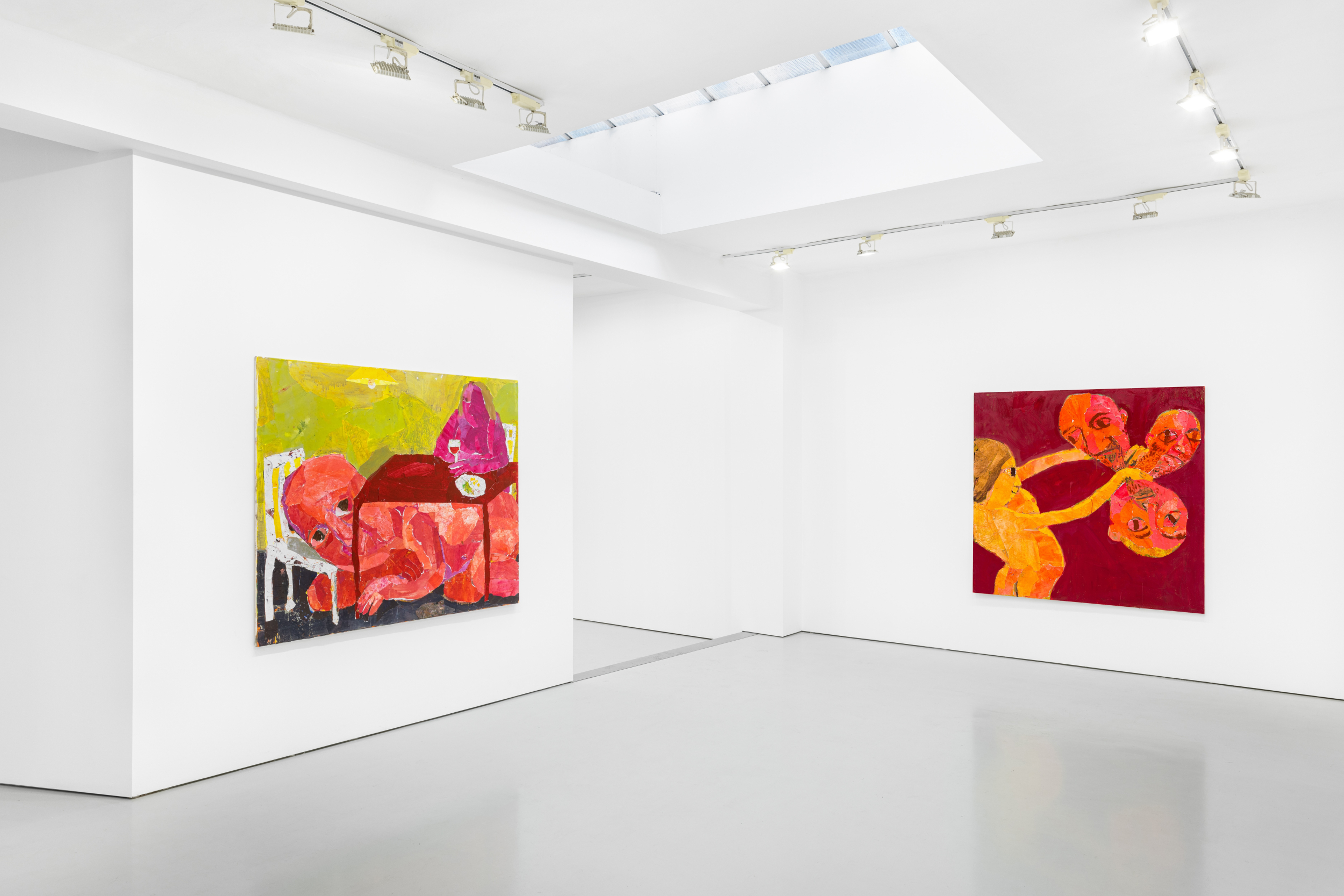
We are pleased to present Intimate Gaps, the first solo exhibition for Shanee Roe at Luce Gallery. Opening September 20th, the show will feature nine paintings — many incorporating collaged elements — on view through October 18th. Roe's paintings explore intimacy, interpersonal relationships, and power dynamics through vibrant characters that highlight the tension between connection and disconnection. Her works portray clumsy, playful attempts to bond, while revealing the underlying anxieties and emotional struggles within close relationships. Using a saturated palette, Roe's figures are both ‘cute’ and disturbing, featuring large, boulder-like heads with wide, glaring eyes designed to evoke both compassion and unease. Together, the paintings in Intimate Gaps expose the often overwhelming nature of our existential feelings of loneliness, fostering important conversations about dynamics that shift from playfully warm to distant and potentially abusive.
The exhibition’s title, Intimate Gaps, with the use of sense of humour and “silly” situations describes the abyss between bodies seeking closeness the visceral yearning for connection. These ‘gaps’— though physically slight— become chasms of apprehension. They represent the very absence of what we desire to feel fulfilled.
In each painting, Roe stages intimate moments where her characters make clumsy, often playful attempts to connect. Yet, the physical exaggeration of closeness only amplifies the emotional disconnection and awkwardness of the figures. Nudity plays a crucial role in this, symbolizing raw vulnerability and exposing individuals in their most primitive, innocent form. Roe often portrays her male figures as disembodied heads, reflecting her belief that the nude male body can be intimidating. Their immobility makes them appear harmless and open to connection, yet at other times, it leaves them vulnerable and helpless. This creates a disconcerting dynamic where attempts at physical connection cannot be fully resolved through the body. These heads also reference an art historical prescient, the vicious severed male heads in the paintings of late-Renaissance artist Artemisia Gentileschi, evoking violent associations. This contrast with the soft, gentle, and playful treatment of Roe’s bodiless figures adds an intriguing layer of complexity to her work.
Her compositions, often derived from her line drawings, take on new life in their transition to painting. Roe likens her use of incorporating bold, saturated colors to a melody added to a poem, building tension and creating atmosphere, while her collaged elements add texture and depth, further animating the rawness of each emotion. Stylistically, Roe draw inspiration from contemporary figurative painters such as Nicole Eisenman and Dana Schutz, as well as the humorous caricatures and emotional intensity of paintings by artists like Canadian-American painter Philip Guston and the German Expressionists, such as George Grosz.
Rather than offering clear narratives, Roe creates scenes that invite viewers to observe and ask questions. She sees her role as setting the stage, layering tension and amusement, while allowing viewers the freedom to interpret the complexity of these intimate relationships through their own experiences. Her playful yet probing approach encourages viewers to explore the dynamics of relationships, seeking motives and discovering nuance in the details.
The strength of Roe’s work lies in her ability to disarm serious subject matter through humor, encouraging deep engagement and reflection. By tapping into the psychological complexities of intimate relationships, she instills a sense of compassion and insight into the emotional landscape of connection and the tension of distance.
Shanee Roe (American, b.1996) is a Berlin-based interdisciplinary artist whose practice spans painting, collage, drawing, and animation. Her figurative paintings delve into interpersonal dynamics, examining various modes of intimacy—from misery to passion— while exposing complex power relations between genders. Roe navigates the spectrum from overt sexuality to compassion with nuanced sensitivity and humor. In 2023, she graduated from the Academy of Fine Arts Vienna studying under Daniel Richter. Roe has also participated in prestigious artist residencies, including The Cabin in Los Angeles, which culminated in a solo presentation. Her work has been exhibited widely throughout Europe and North America, in major cities such as Berlin, Dallas, Leipzig, Los Angeles, Miami, Mexico City, New York, Tel Aviv, and Torino, among others.
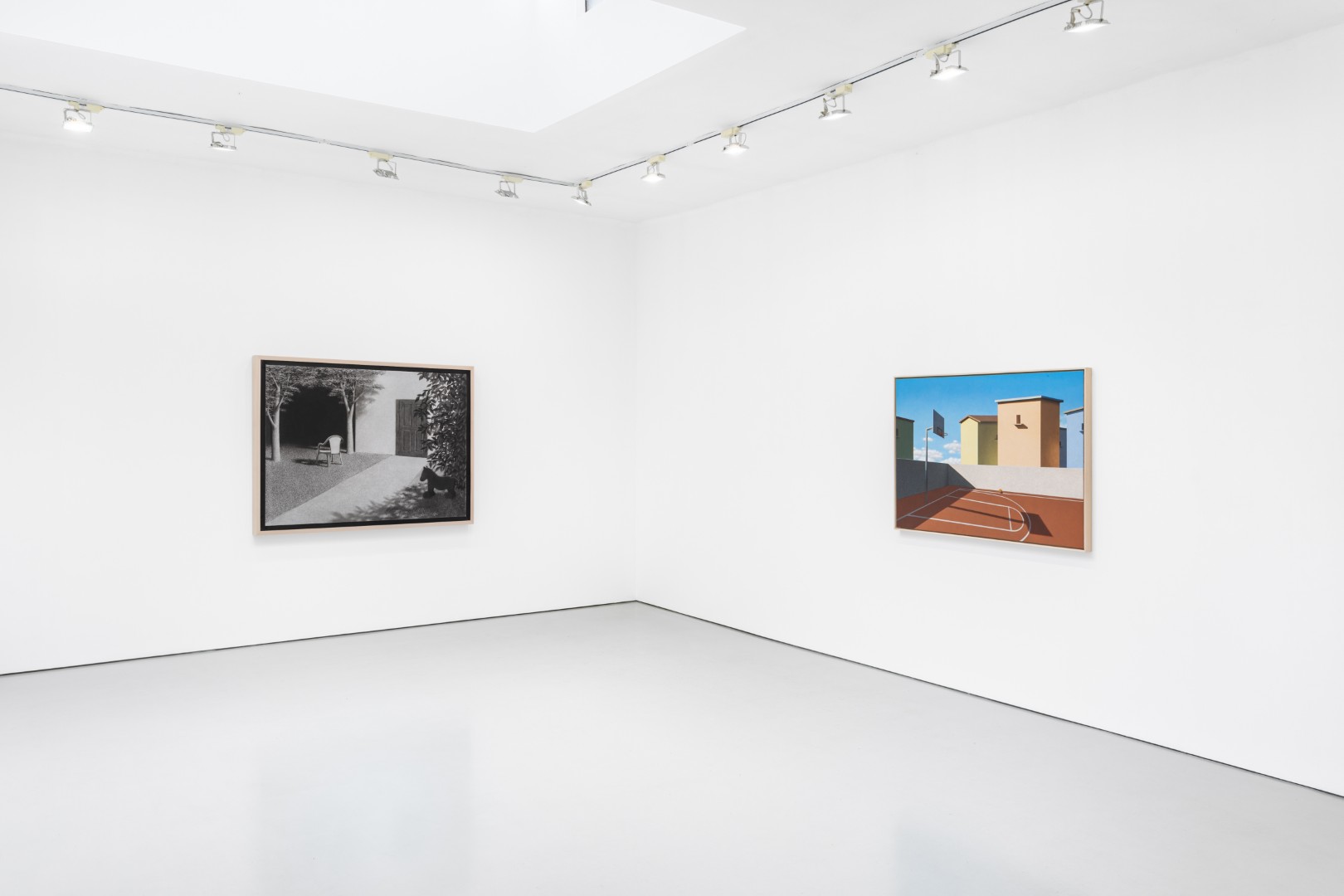
We are pleased to announce the highly anticipated Coro a Bocca Chiusa, Francesco Pirazzi’s first solo show with Luce Gallery. Beginning June 27th, six paintings and two charcoal works on paper mounted on canvas will be on view through August 2nd.
Pirazzi's distinctive use of dramatic light within cityscapes and landscapes illuminates the mystery of each scene. In this series of new works, the artist cautiously navigates the changes to his environment after relocating to Turin from Florence. What unfolds are observations from a distant high vantage point, gradually pulling in closer from painting to painting. Thoughtfully placed lampposts, trees, and buildings set the stage for narratives that feel unusually familiar yet lost to time and space. When viewed together, the artworks in Coro a Bocca Chiusa evoke a sense of mystery, enticing viewers to examine each scene for the subtle cracks in reality and to question each illuminated path.
The exhibition’s title, Coro a Bocca Chiusa (The Humming Chorus), is inspired by the song of the same name from Giacomo Pucci’s opera Madame Butterfly. As a student, Pirazzi’s art instructor would play classical music while they painted, and when looking for a title that encapsulated the theme of this show, this just fit. He appreciated the mental image this song creates of many people singing with their mouths closed, creating an intimate collective hum radiating from within. Much like a humming choir, his paintings convey emotion without words and vibrate with intention.
In these paintings without people, the narrative power is turned over to the inanimate objects. His actors are the trees, street lamps, buildings, and vacant streets, which are anthropomorphized to create conversations, giving them personalities and a strong presence. Each scene is enhanced through his theatrical spotlights and subtle use of natural or exaggerated sunlight light to guide or illuminate the story. Although his scenes were initially based on real places around Turin, Pirazzi created his compositions from memory, divorced from the original image, distilling the objects and surroundings into their simplest forms. Historically, his style seems to recall the atmosphere and intrigue of American social realist Edward Hopper, the shifting reality of Italian painter Giorgio de Chirco, and the tenebrism and dramatic illumination of Baroque artists like Rembrandt and Caravaggio.
In the seminal painting, Simulazione (2024), the viewer’s perspective has shifted noticeably closer to an observed vacant playground. Here, we are invited — or perhaps lured — inside the fenced enclosure through a gate blown slightly ajar. At the entrance, a red wooden horse ride on a spring is angled toward us as if distinctly aware of our presence. Pirazzi often uses children’s toys and playground sets in his works, appreciating that to a child with an active imagination, they are ‘real,’ and thus, for the artist, they become animated within this world. The entire scene feels artificially lit during a cloudy afternoon as if a bright spotlight from above has bathed the entire park. The suspicion of being watched is furthered by the three windows of the nearby building, their shades lifted to varying heights, through which we can only see darkness. Even the trees feel sentinel-like, reminiscent of the fighting trees from The Wizard of Oz, waiting to spring to life. But perhaps this is all just a racing imagination, and instead, the story intended is simply a deserted playground waiting for someone to give it life again. In either interpretation, Pirazzi’s compositions are an invitation to observe, interpret, and draw your conclusions — the mystery is our reality.
Pirazzi’s compositions dwell in the space between physical existence and perceived reality. The strength of his work lies in his uncanny ability to create a layered world that blurs the distinctions between familiar, foreign, and slightly ‘off.’ Instead of providing a distinct narrative, he illuminates the elements we should question rather than provide us with the answers. The only thing that is ever certain is the mystery.
Francesco Pirazzi (Italian, b.1994) is a painting and drawing artist who lives and works in Turin, Italy. His surreal yet quiet Italian-inspired land and cityscapes explore the profound power of light, refocusing the viewer's experience of reality to evoke both familiar and mysterious sensations. In 2018, Pirazzi graduated from the Academy of Fine Arts in Florence, studying painting under Master Adriano Bimbi. His work has been exhibited throughout Italy, and internationally, including the Augustenborg Project in Augustenborg, Denmark; Cob Gallery and The Artist Room in London, UK; The Hole Gallery in New York, NY.
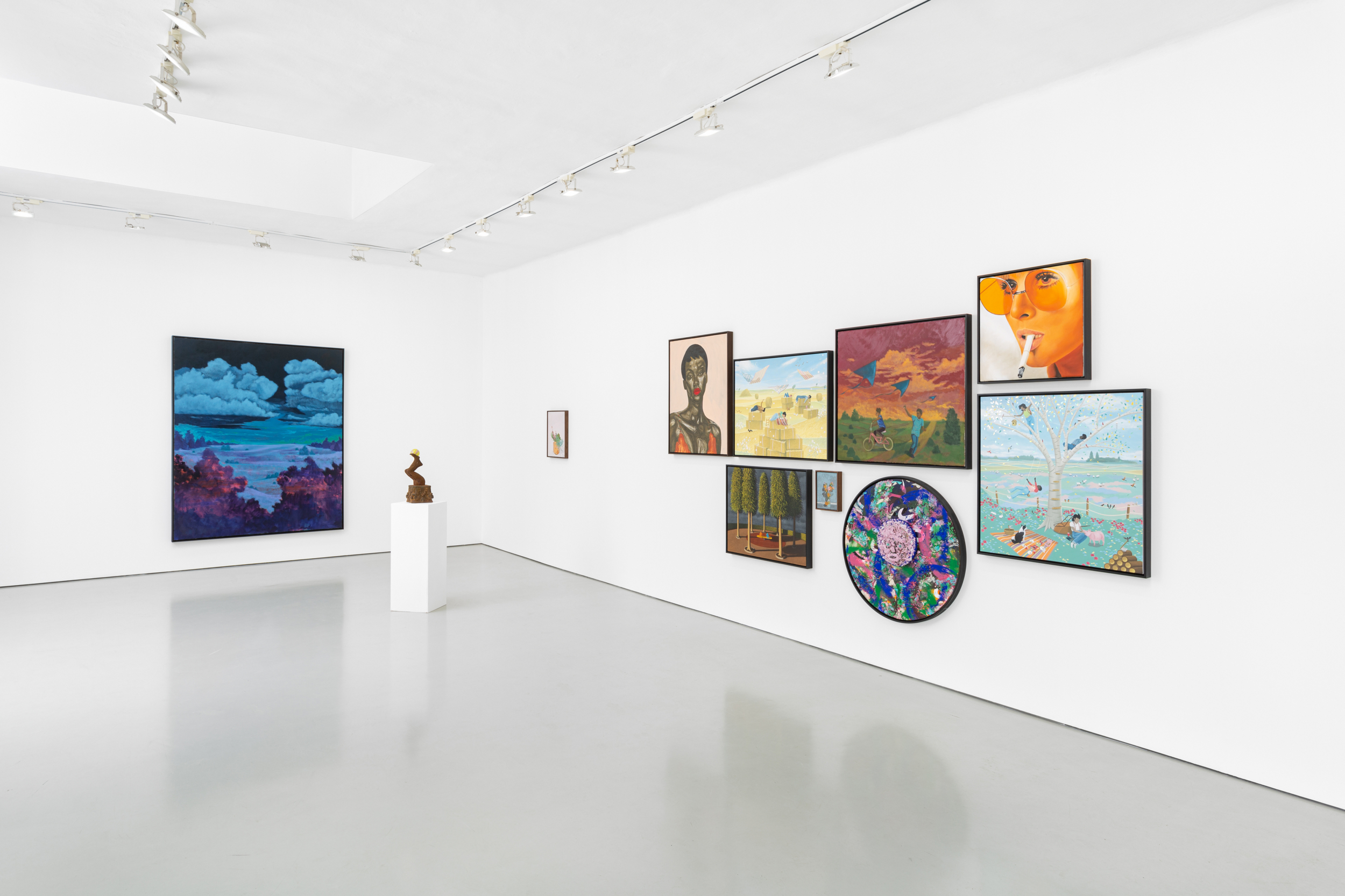
Luce Gallery is thrilled to announce our special anniversary group presentation, Fifteen Years.
This show celebrates the gallery's milestone and features new works by a selection of the artists we work with, including Dominic Chambers, Ryan Cosbert, Robert Davis, Derek Fordjour, Connie Harrison, Yowshien Kuo, Hugo McCloud, Johanna Mirabel, Peter Mohall, Demarco Mosby, Ludovic Nkoth, Collins Obijiaku, Zéh Palito, and Francesco Pirazzi. Opening May 16, the exhibition showcases the incredible talent and diversity of artistic style of our artists, some of whom have been with us since the inception of our gallery, as well as recent additions to the program. This show honors our partnership and journey with these artists, whether they have already achieved career stardom or are just beginning to make their mark. Fifteen Years offers a profound moment of pride and reflection, encapsulating Luce Gallery's mission to discover and support international emerging artists, enriching our ever-expanding gallery program.
With director and founder Nikola Cernetic at the helm, Luce Gallery's mission has always been to seek out new talent and provide spaces for their artworks to gain a wider audience. In a recent interview, Cernetic explained:
"I opened Luce Gallery in a very romantic way, and to this day, that spirit persists. I've never chosen an artist solely for a commercial reason; I ask them to join my program because I love and believe in their work and vision. Searching for these artists and being the first to discover them is perhaps the most interesting and rewarding part of my job as a gallerist. What distinguishes Luce from other galleries today is really our strong program of international artists and consistent discovery of new artists."
Over the years, the gallery's roster has been assembled to include artists from more than eight countries, including many hailing from the United States. The program currently excels at painting, displaying the full breadth of this medium from dynamic abstraction to hyperrealism, palpable textures to seemingly invisible brushstrokes, and often incorporates elements of mixed-media or collage used to heighten conceptual meanings. With a strong focus on providing under-recognized artists with a platform to exhibit and a partnership to provide support, we are always searching for unique talent with a distinctive quality from around the globe and in every medium.
To date, the gallery has hung seventy-seven exhibitions, participated in sixty-five art fairs across Europe and North America, and helped organize several well-received institutional shows for our artists, including a recent solo show of Zéh Palito's work at the Museo de Arte Contemporáneo Querétaro in Mexico. Luce Gallery has distinguished itself through its unwavering commitment to emerging artists for fifteen years, and this show encapsulates that vision.
Included in the nineteen newly made artworks on view are a selection of works by artists who have collaborated with the gallery the longest, including a 1970's inspired portrait by Robert Davis, two floral still-life paintings —composed with his signature single-use plastic technique—on panel by Hugo McCloud, a tranquil leisure landscape by Peter Mohall, and featuring a playful sculpture by Derek Fordjour of upturned legs precariously balancing a glass yellow ball. In recent years, other noteworthy artists such as Dominic Chambers, Ryan Cosbert, Yowshien Kuo, Johanna Mirabel, Demarco Mosby, Ludovic Nkoth, Collins Obijiaku, and Zéh Palito have joined the fold. Each brings a distinct 'language' of painting incorporating elements of surrealism, portraiture, and abstraction, expressing the complexities of race, gender, humanity, and memory. Additionally, the newest members to the program include two artists inspired by the landscape, Connie Harrison creating dense abstracted gardens both painted and excavated from oil and wax layers, and Francesco Pirazzi harnessing the mysterious nature of light in a surrealist style, with both artists debuting their solo shows later this year.
When viewed collectively, the artworks in Fifteen Years narrate a tale of the strength of Luce's program and the significance of the gallerist-artist relationship. Here, their devotion to creation is matched with our belief in their talent and abilities. We would also like to reserve a moment to thank our collectors—small and institutional—who have supported both our artists and this gallery's vision every step of the way. Thank you for joining Luce Gallery as we embrace this milestone with open arms and toast to now and to the next Fifteen Years! Salute!
Dominic Chambers (American, b.1993) is a New Haven-based artist originally from St. Louis, Missouri. He paints introspective scenes that illustrate both the interior and exterior self and how this duality co-exists using a bold, vibrant palette. Chamber's surrealist-inspired work draws on both historical and art historical references and is grounded in his experiences as a Black man.
Ryan Cosbert (American, b.1999) is a Brooklyn-based conceptual artist working in abstraction. Her work draws from her Haitian and Guyanese heritage, humanistic experiences, self- expression, political issues, and rigorously researched historical narratives of the African diaspora. Cosbert skillfully explores the repercussions of subjugation and oppression experienced by the Black community, often shedding light on overlooked Black historical figures, shared experiences, and profound beliefs.
Robert Davis (American, b.1970) was born in Virginia and currently lives and works in Brooklyn, NY. His hyperrealistic paintings and drawings depict nostalgic scenes from the 1970s, often recalling images from popular culture or his vivid childhood memories. Davis' work invites viewers to reflect on the past, encouraging them to form deep personal connections to the subjects and spaces he portrays.
Derek Fordjour (American, b.1974) is an interdisciplinary artist of Ghanaian heritage who works across painting, sculpture, collage, video/film, and installation. Inspired by athletes, musicians, performers, and other Black cultural creators, Fordjour's artworks explore the vast physical possibilities of the human body while anchoring each subject within a broad social commentary. His works feature colorful, textural surfaces paired with energetic subjects, creating a seamless blend of physicality and conceptuality that evokes complex emotions.
Connie Harrison (British, b.1993) is a painter based in London who specializes in vibrant abstracted landscapes. Her technique involves overlaying multiple compositions of oil paint and wax, which she then carves to reveal underlying depths. This process serves as a metaphor for nature's natural rhythms and life cycles. As Harrison works, different parts of the surface evolve in texture, opacity, and color, creating movement and adding physical depth to the painting, as if simulating growth.
Yowshien Kuo (American, b.1985) is a St. Louis-based painter whose surrealist work blends his experiences as a Taiwanese American with historical references that comment on social and racial inequality, cultural constructs, sexuality, and the human condition. Incorporating Asian- American figures with American Western undertones, Kuo conveys universal experiences and traditions through detailed narratives and symbolism.
Hugo McCloud (American, b.1980) is a self-taught artist based in Los Angeles. Drawn to unconventional materials, he creates detailed representational works using his technique of 'painting' with single-use plastic bags that fuse industrial products with traditional painting, collage, and printmaking techniques. By using ubiquitous materials like single-use plastic, both McCloud's materials and subject matter directly address issues of labor, geopolitics, and environmental concerns, providing us with a deeper connection to our humanity.
Johanna Mirabel (French, b.1991) is a Paris-based painter whose work explores the intimate connection between our inner thoughts and interior spaces. By combining symbolic hues, tropical plants, household objects, and suggestions of exterior spaces with detailed portraits, the artist creates deeply intimate works that explore the immersive and transportive experience of recalling a memory. Her work draws from her French Guyanese and Martinique-Guadalupe heritage, sociological and philosophical writings, and historical references to Western art.
Peter Mohall (Swedish, b.1979) is a Swedish-born, Norwegian-based artist working in painting. His work explores the history and medium of painting as a subject and how each element contributes to our rich emotional experiences. His scenes of leisure, with picturesque Scandinavian backdrops, are painted on tactile jute surfaces with rich, palpable colors. Mohall further invites viewers into his artistic process by neatly arranging each color from his palette onto his signature acrylic brushstroke casts.
Demarco Mosby (American, b.1991) is a New York City-based figurative painter originally from Kansas City, Missouri. His work is narrative-based and uses the human figure to mirror and reveal the weight and complexity of life's everyday tribulations. By incorporating his symbolic vocabulary of objects like birds, ropes, rocks, and tumultuous landscapes into each composition, Mosby creates layered narratives that aptly visualize the complexity and disorientation of our emotional states.
Ludovic Nkoth (Cameroonian-American, b.1994) is a Cameroonian-American painting artist who now lives and works in New York. Known for fluid figurative works created with undulating heavy brushstrokes, Nkoth infuses his personal life as a Black immigrant with ruminations on family history, tradition, and the legacy of colonialism onto the canvas to manifest the essence of the Black experience.
Collins Obijiaku (Nigerian, b.1995) is a self-taught artist based in Abuja, Nigeria. He employs portraiture to examine the depths, truths, and complexities of humanity, using friends, family, and locals as his sitters. Each expressive gaze is further accentuated by his signature winding charcoal line work, which weaves throughout the sitter's face, reminiscent of 'mapping' their life journey.
Zéh Palito (Brazilian, b.1986) is a figure painter whose vibrant, joyful works celebrate Black culture. With studios in both Baltimore, MD, and Sao Paulo, Brazil, Palito researches neglected histories and gives them visibility in the canon, with each figure represented as a confident protagonist. His work is embedded with details referencing popular culture and traditional Brazilian fruits and flora to further radiate both beauty and joy.
Francesco Pirazzi (Italian, b.1994) is a painting and drawing artist who lives and works in Turin, Italy. His surreal yet quiet Italian-inspired land and cityscapes explore the profound power of light, using it to refocus the viewer's experience of reality to evoke both familiar and mysterious sensations.
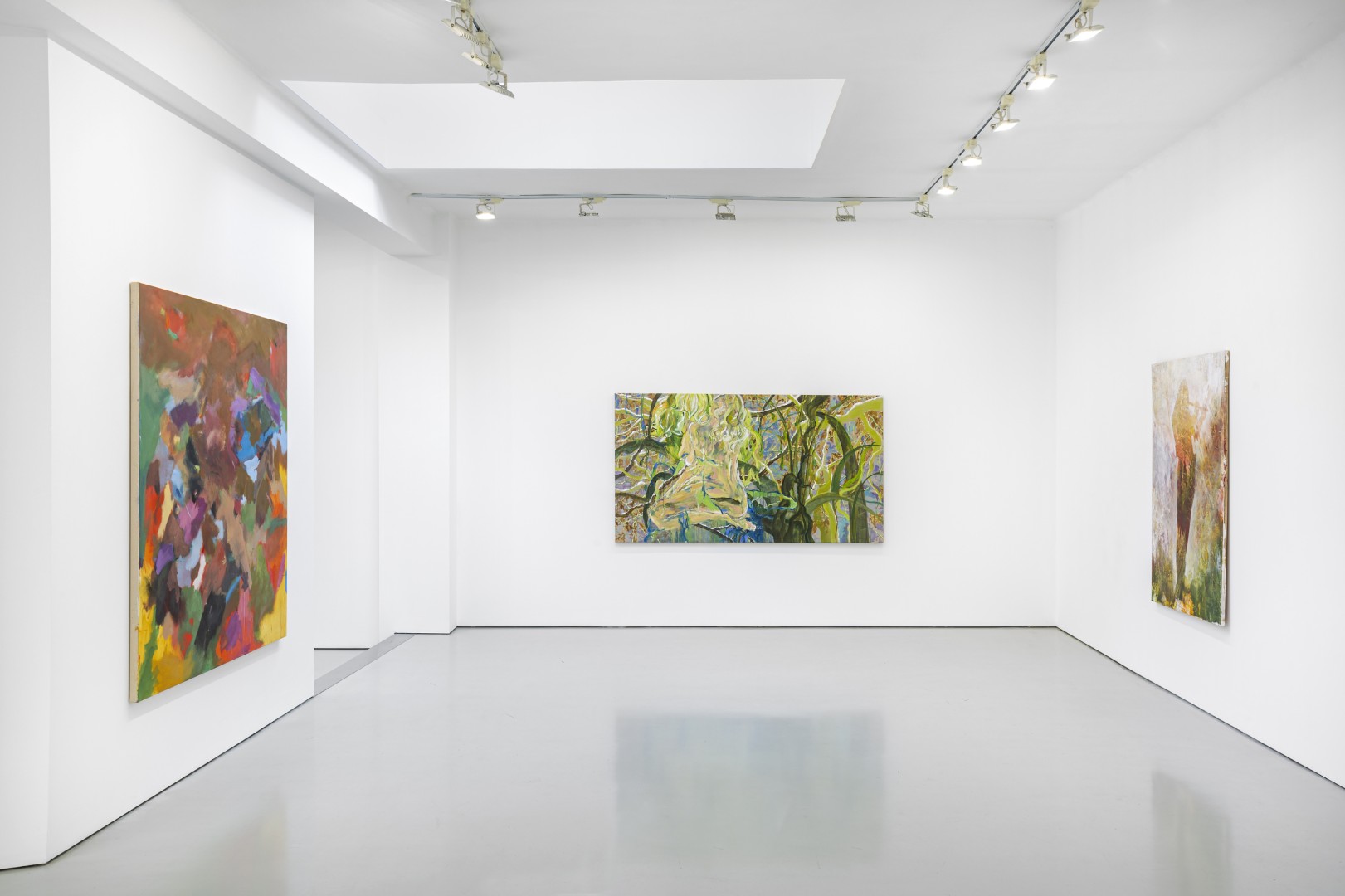
Luce Gallery is delighted to announce our inaugural exhibition of 2024, titled Passages. This group show will feature new works by nine exceptionally talented international artists including: Mary Shangyu Cai, Dante Cannatella, Alice Faloretti, Alya Hatta, Yeonsu Ju, Rômulo Avi Oliveira, Shanee Roe, Jake Walker and Demetrius Wilson. Commencing January 25th, this exhibition brings together paintings that explore the pathways connecting realism and abstraction, both stylistically and conceptually. Passages aims to explore the fluidity of artistic style and viewpoint, unveiling the factors that grant artists the freedom to be guided by life experiences and inspiration.
Like a corridor passing through an entrance toward an exit, the title Passages poetically describes the open path between two distinct schools of artistic practice and thought— abstraction and realism. Within this ‘passage’ there is freedom of movement, to head forward, reverse, or pause at some point in between. The crucial aspect, however, is to keep this pathway open for exploration and to keep one’s artistic practice receptive to all available tools and disciplines. As Philip Guston once aptly stated, "This serious play which we call art can’t be static... you have to keep learning how to play as modern artists. That's our fate, constant change."
As artists grapple with the myriad dimensions of life, there are times when full abstraction becomes indispensable to an artist’s practice, as exemplified by British artist Jake Walker. In his paintings we witness an energetic frenzy of brushstrokes taking the form of dashes, streamers, comets, and dabs, all dancing to an unheard rhythm across the canvas. Walker's compositions astutely capture key evidence of the body moving through space and envisions what line weight, length, and hue would best describe each dance step.
In other instances, the creation of artworks leans more towards figuration to manifest more complex and abstract concepts. In Yeonsu Ju’s Sealed With a Kiss, we encounter a self-portrait of the artist seated, her mouth agape as if ready to speak, holding up a rectangular object close to her face as if presenting it to the viewer. Here, the artist creates a space not only to mourn and remember her departed loved ones, but also to emphasize the discomfort of acknowledging those feelings. Ju introduces this subtle unease with the candelabra in the foreground engulfed by flames and burning red hot.
When considered collectively, the paintings in this exhibition converge to create these metaphorical Passages, accentuating the fluidity of style and concept among contemporary artists. Viewers are urged to transcend the constraints of traditional artistic genres, and instead reflect on the interplay between form and emotion. This contemplation allows for a deeper understanding of why an artist chose to embrace a particular style and welcomes you to explore the many Passages.
Mary Shangyu Cai (1999, Beijing, China) is a painting artist based in London, UK, whose dynamic work explores the relationship between humanity and landscapes, celebrating the unity of living beings. Influenced by nature and literature, Shangyu is known for her vibrant use of light- derived hues, emphasizing hope, vitality, and the ethereal allure of landscapes.
Dante Cannatella (1992, New Orleans, United States) is a figurative painter originally from New Orleans and currently residing in Brooklyn. His paintings embrace an imaginative version of reality derived from personal experiences, memories, and dreams. Rooted in the landscapes of South Louisiana, his work portrays emotive figures through tactile paint and illusionary light, exploring relationships and narratives with an intuitive, improvisational approach.
Alice Faloretti (1992, Brescia, Italy) is a contemporary artist based in Venice, Italy. Her vibrant kaleidoscopic landscapes investigate the intricate relationship between humans and their surrounding environment. Through a dynamic dialogue between paint, drawing, and digital, Faloretti explores episodes of personal and collective experiences, intertwining the concrete and the imaginary to form new connections.
Alya Hatta (1999, Malaysia) is an interdisciplinary artist based in both London, England and Kuala Lumpur, Malaysia. Her work delves into her Southeast Asian identity, portraying the colorful intimacies of the diasporic human condition through personal experiences and memories. Utilizing both paint and locally sourced found objects, Hatta creates alternate realities in a quest to find new spaces she can call home.
Yeonsu Ju (1995, South Korea) is a painting artist currently living and working in London, UK. She sees painting as an imaginary space where we can meet lost loves. She repeatedly portrays dining scenes, she consider herself as a host who invites people in order to meet them. She further represents herself within the canvas as a figure of multiple forms.
Rômulo Avi Oliveira (1992, Sorocaba, Brazil) is an abstract artist living and working in London, UK. His vibrant tactile paintings explore movement, alchemy, and transformation. Through unconscious mark-making, opposing colors, and the layering and removal of gesso and paint, Oliveria works serve as a poignant reminder to appreciate fleeting moments and the impermanence of life.
Shanee Roe (1996, New York, United States) is an Israeli artist who lives and works in Berlin. Roe's figurative paintings delve into interpersonal situations, exploring various modes of intimacy, from bare nudity to misery and passion. Through her work, she exposes the complex power relations between genders, navigating the spectrum from blatant sexuality to compassion.
Jake Walker (London, United Kingdom) is a multidisciplinary artist and DJ based in London, UK, whose practice spans ballet, video, sound, drawing, and painting. His exploration of the dynamics of body movement and its interplay with diverse artistic mediums is evident in his abstract paintings. Using textured brushstrokes, Walker visually translates sound and movement into rhythmic and colorful visuals on canvas.
Demetrius Wilson (1996, Boston, Massachusetts, United States) is a New York-based artist hailing from Boston, MA. Working in abstraction, his paintings explore the interplay of stillness and activity, embracing impermanence while narrating stories through evolving colors. Wilson's work challenges visual perception by distorting rather than blending past and present, with adaptation and the linguistic relationships of color emerging as central themes.
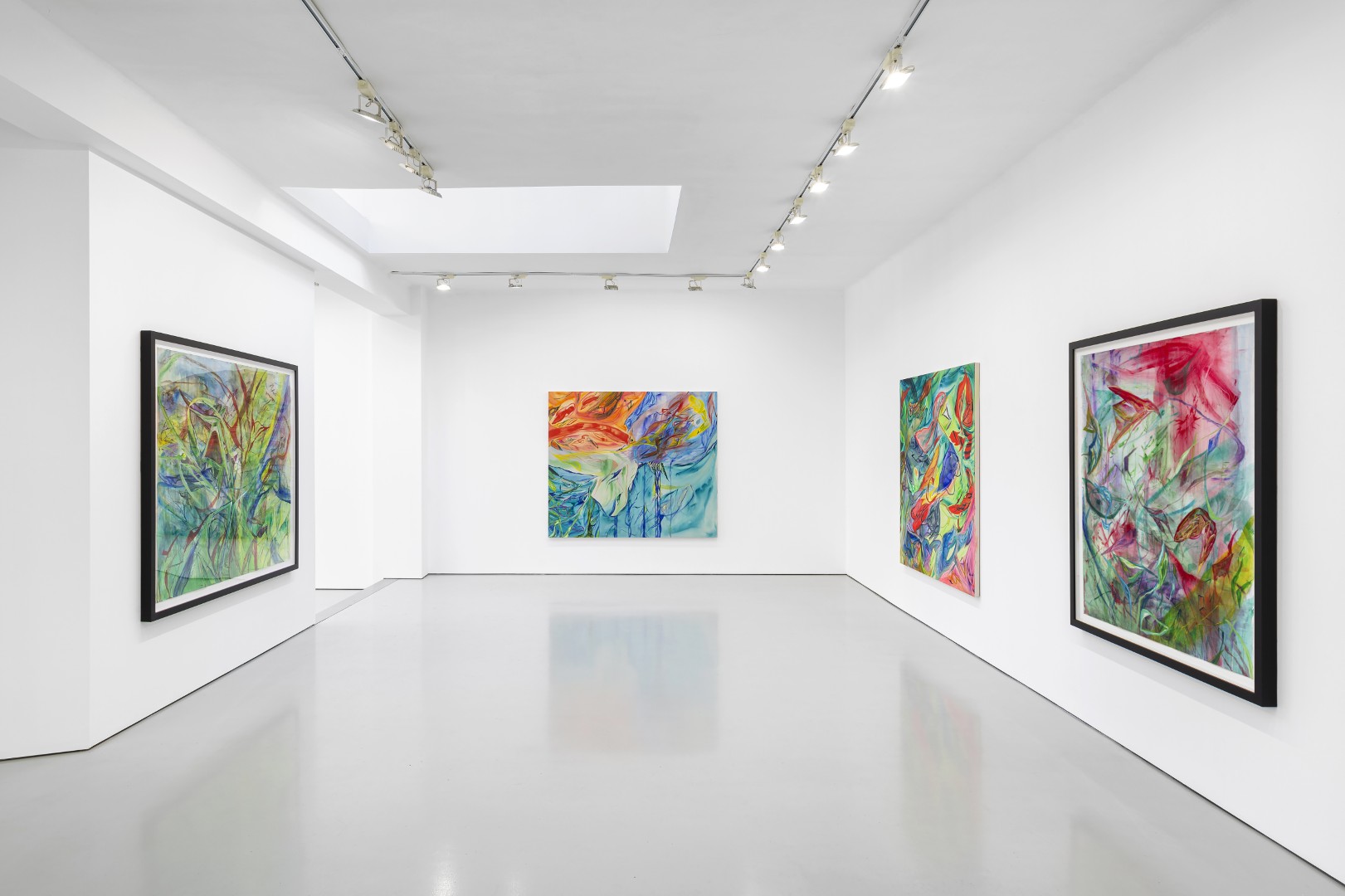
We are delighted to announce All of Civilisation on a Leaf, the first solo exhibition for Mannat Gandotra at Luce Gallery. A series of large-scale vibrant paintings will be on view beginning November 28th running through January 12th. Gandotra is a London-based painter who creates lyrical abstract paintings with a bold color palette, visible brushstrokes, and distinctive lines, all formed through spontaneous gestures. Her work is diaristic, visualizing her personal experiences and perceptive observations, imbuing a spectrum of sentiments onto the canvas. When viewed together, the paintings in All of Civilisation on a Leaf, seek to explore the complexity and intensity of our emotions by enveloping viewers in a seductive dissonance of form and pigment.
The exhibition's title, All of Civilisation on a Leaf, is borrowed from a painting she created earlier in her career that felt deeply relevant to this body of work. For Gandotra, this phrase served as a prompt, inspiring robust visual compositions that encapsulate the vastness and intricacies of our human existence, condensed and distilled until it finds a perch on a humble leaf, or in this case, within the confines of the canvas.
Growing like wild gardens, Gandotra’s forms flourish in chaos, with colors vying for attention, and lines dancing to silent tunes. Her works seem to capture moments of pure opposition, yielding equal parts creation and destruction, condensing and expanding. In her search for inspiration, she is drawn to unconventional details or elements out of place, such as a flowing river disrupted by protruding rocks or smooth wood grains interrupted by gnarly knots. Her objective is always to look beyond the symmetry and precision of traditional beauty, instead aiming to emulate and emphasize the imperfect imperfections in our world. To achieve this, she paints intuitively, allowing the fluidity of brushstrokes and pools of color to guide her toward compositions, forming a collaborative effort between creation and creator. In the studio, she often works on these paintings in groups simultaneously —like those on view here — giving them shared characteristics akin to siblings sharing the same womb.
In Asking for a Stampede (2023), garish pink, cobalt, and neon-orange shapes swirl in a sea of pale chartreuse and algae-green forms. The composition pulls towards and away from each side and corner, offering no clear orientation, granting freedom to the viewer for exploration in any direction. As the eye traverses the canvas, darker areas of saturated teal draw you deeper below the surface, encouraging contemplation. Meanwhile, brighter patches of lime green energize and excite, lifting your gaze to the shallow surface, and evoking a sense of anticipation. In this piece, echoes of Wassily Kandinsky's musicality and the pure expressionism forms of artists like Lee Krasner are evident.
Overall, this painting embodies a tension between light and dark, diaphanous and opaque, perhaps hinting at one element waiting for its moment to swiftly eclipse the other, as the title alludes. Yet, as with all of the artist’s titles, they are not meant to be narrative or conceptual. Rather she likens them to how we name children, where an individual’s name serves to identify them, rather than be used to define or express their entire story.
The strength of Gandotra’s work lies in how she communicates a genuine spontaneity by skillfully manipulating forms, line weight, and opposing colors, to guide the viewer towards feeling rare and powerful emotions reminiscent of fleeting joyful laughter or a fluttering heart in love.
Mannat Gandotra (b. 2001, New Dehli, India) is a London-based painter working in lyrical abstraction. A discerning observer, she draws inspiration from facets of her daily life and experience as a young British-Indian woman in search of the unconventional to create paintings that are lively, emotive, and saturated with color. Gandotra graduated with a BFA in 2023 from the prestigious Slade School of Fine Art, UCL in London. She has exhibited in the United Kingdom and the United States, and she’s currently a student of the Royal College of Art in London.
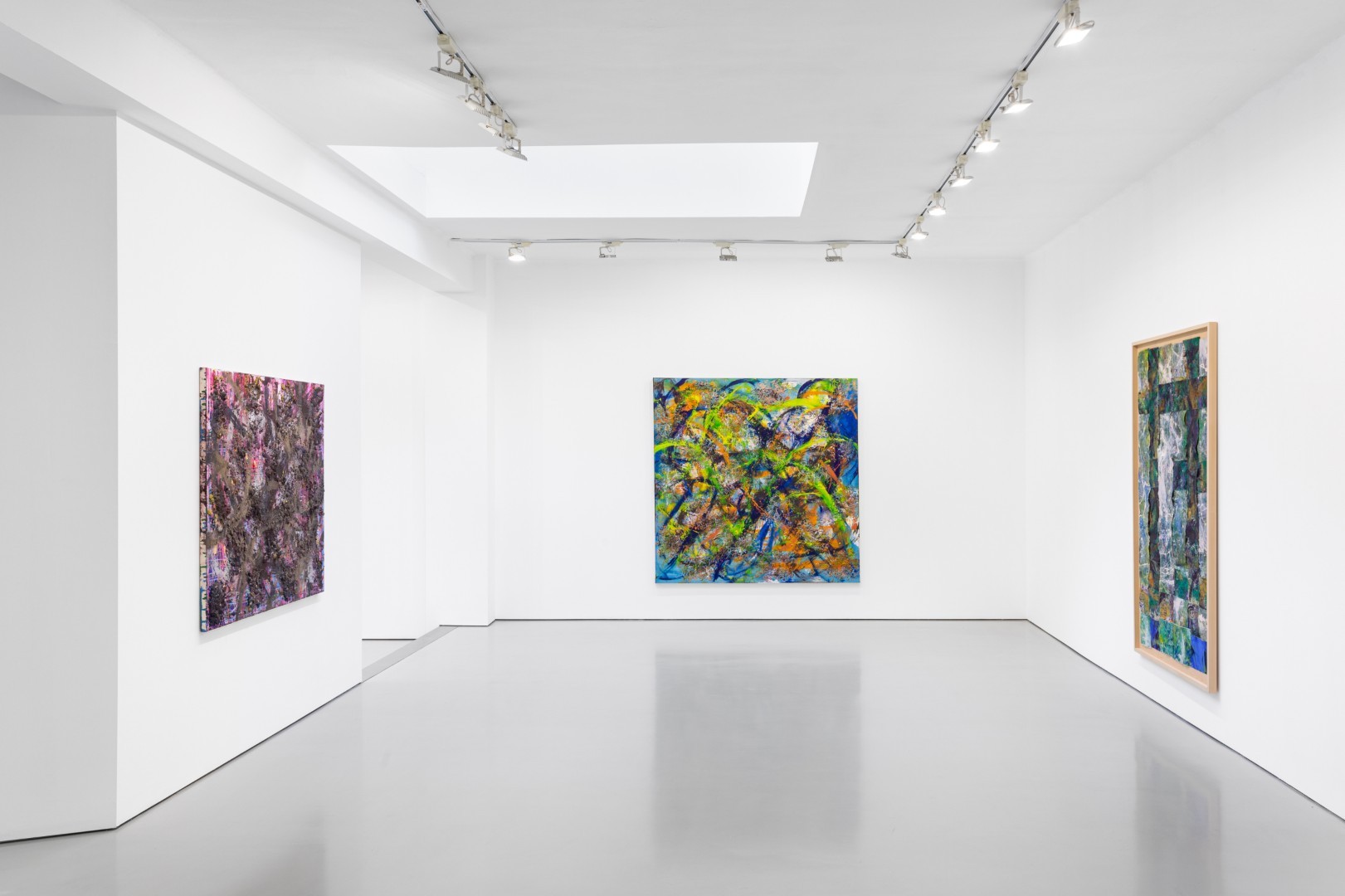
Luce Gallery is pleased to present Woven Memories, the much anticipated second solo exhibition with Brooklyn-based artist Ryan Cosbert. Including canvases hand-woven with mixed fabrics and knit pieces into her signature ‘tiles’, the exhibition will be on view beginning September 21st through November 5th. Cosbert’s distinctive tactile abstraction serves as a conduit to convey conceptual ideas deeply rooted in Black culture. In this series, the artist takes a scientific approach to explore the legacy of intergenerational trauma stemming from slavery, segregation, and urban violence. When viewed together, the paintings in Woven Memories channel protective ‘guardians’ from traditional African sculpture, seeking to trace the origins of inherited pain while also posing critical questions around the burden of past traumas on contemporary Black individuals.
Cosbert's thought-provoking exhibition title, Woven Memories, serves as a profound reflection of her extensive exploration into the realm of epigenetics. Epigenetics delves into the study of how an individual's behaviors and environment can trigger changes that impact the functioning of their genes. This research investigates how war, famine, sexual abuse, and systemic traumas such as racism possess the potential to send ripple effects through generations. These traumas may then lead to offspring inheriting altered brain chemistry, often resulting in compromised mental health and inflammation — a fundamental contributor to various diseases. With a remarkable body of work informed by thorough investigations into both historical and modern-day events within the African Diaspora, Cosbert brings to light and vividly portrays the origins of these previously concealed afflictions. In each artwork, the artist masterfully reveals how these invisible forces are intricately interwoven at the deepest cellular level, most notably through the incorporation of found objects. Broken watch faces and gears symbolize the inexorable passage of time, and bullet casings recall the violence, while infant diapers and pacifiers poignantly remind us of the inheritance passed down to the next generation.
In her captivating tondo painting The Void (2023), Cosbert skillfully paints a luminous backdrop, luring viewers into its embrace with a palette of blush fluorescent pinks and pale minty greens. Upon closer examination, the surface of the painting reveals an intricate landscape composed of mounds of square 'tiles.' These tiles are expertly crafted from recycled materials, including pulverized plastics, crushed dried flowers, and seashells, forming a grid-like structure with textures reminiscent of coral beds. Further energizing the composition are the prominent splatter marks of paint across the surface, a homage to the abstract expressionist action-painting style. However, it is the central motif that truly captivates the observer's attention — a spiral of fallen dominos that gracefully collapses toward the heart of the painting, echoing the circular shape of the tondo. This inclusion of dominos carries profound symbolism, serving a dual purpose. First, it harks back to their historical significance as objects of leisure deeply intertwined with African American culture, dating back to the era of the American Civil War. Second, it embodies the concept of the figurative "domino effect."
For Cosbert, this spiraling motion symbolizes the transfer of trauma, a force that affects individuals at various stages of life, relentless and inevitable. The dominos represent an unstoppable and interconnected chain reaction, much like the unfolding consequences of generational trauma. In this painting, the artist compels us to confront the unyielding nature of this force, urging us to acknowledge and grapple with the enduring legacy of trauma that shapes our lives.
Nevertheless, amidst even somber reflections, there is always a ray of hope. Just as epigenetic changes do not irreversibly alter one's DNA sequence, Cosbert artfully reminds the viewer that familial traumas need not permanently shape their life trajectory. Her artistic objective lies in imparting knowledge and nurturing the healing process for the profound ancestral wounds that persist. Through her work, she seeks to empower individuals with the strength to confront and transcend the burdens of the past, ultimately fostering a brightly-hued path towards healing and transformation.
Ryan Cosbert (1999, New York, United States) is a Brooklyn-based conceptual artist working in abstraction. Her work draws from her Haitian and Guyanese heritage, humanistic experiences, self-expression, political issues, and rigorously researched historical narratives of the African diaspora. Through her artistic practice, she skillfully explores the repercussions of subjugation and oppression experienced by the Black community, often shedding light on overlooked Black historical figures, shared experiences, and profound beliefs. Cosbert graduated with a BFA in 2021 from the prestigious School of Visual Arts (SVA) in New York City where she distinguished herself, receiving multiple honors including the Barnes Foundation Scholarship (2021) and the Chairman’s Merit Award (2017-21). Cosbert has exhibited throughout the United States and Europe, including a number of art fairs, Felix Art Fair in Los Angeles, CA; both NADA and Untitled Art in Miami, FL; Dallas Art Fair in Dallas, TX and 1-54 Contemporary African Art Fair in London, UK and New York, NY. Additionally, her work has been acquired by numerous private collections and public institutions.
New York, NY – May 2023
“Leisure is neither an escape from the world nor a refuge from it. It is a way of engaging with the world on our own terms, of taking time to explore our desires and our dreams, of cultivating the capacity for joy, for wonder, for delight, for laughter, for pleasure, for love.”
– Fred Moten
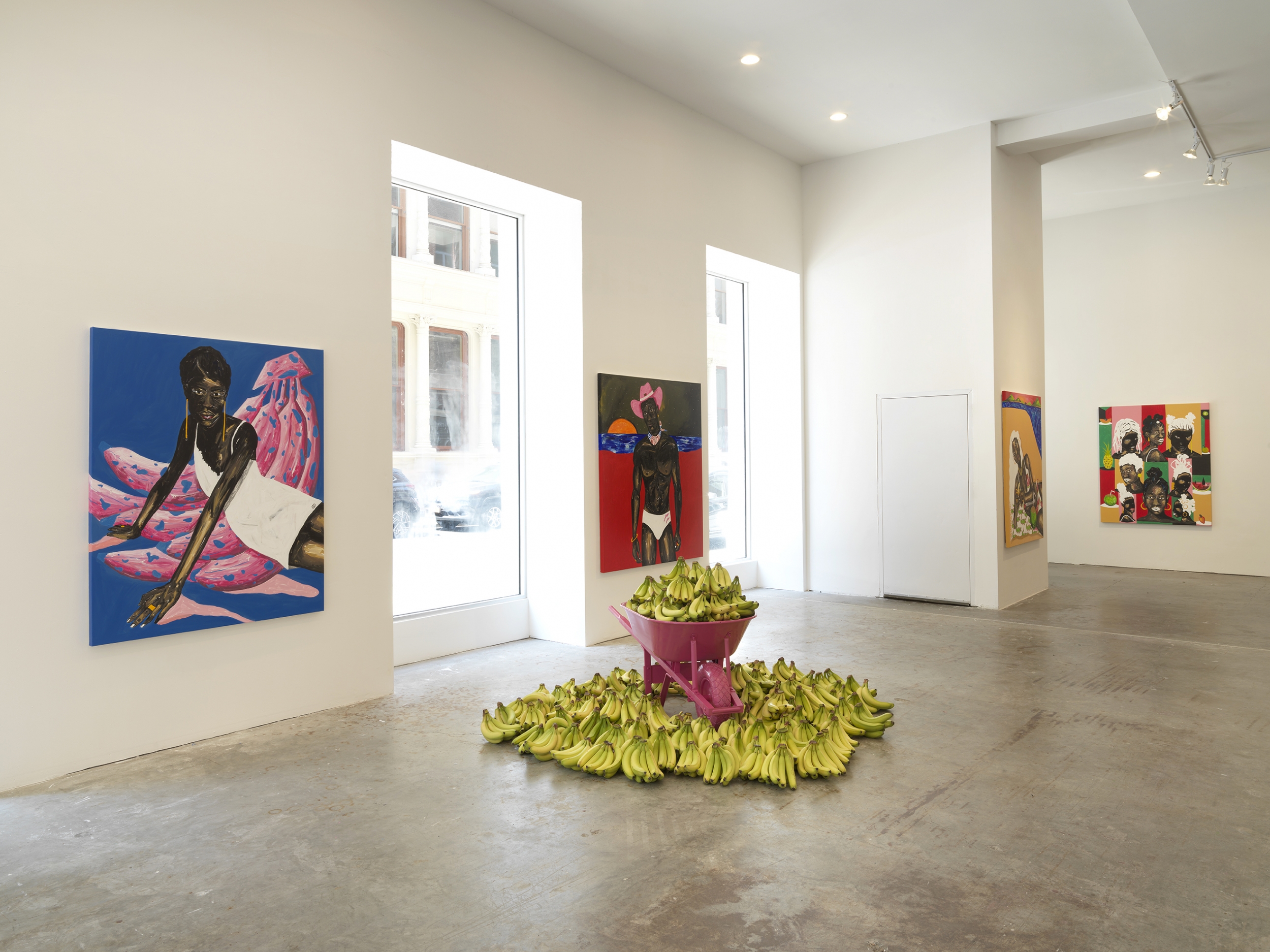
Luce Gallery proudly presents Won’t You Celebrate with Me, the New York City solo exhibition debut by Afro-Brazilian visual artist Zéh Palito curated by Larry Ossei-Mensah. Opened on May 19, the exhibition, born as a special project, will be on view through Saturday, June 10 at Luce Gallery in New York City residence, 365 Broadway.
The exhibition is a clarion call by Palito, inspired by the legendary Baltimore poet Lucille Clifton’s poem of the same name. A response to the rhythm and urgency of Clifton’s poem, Palito’s exhibition of works captures the essence of Black life in respite, at ease, and at peace through vivid dreamscapes. Won’t You Celebrate with Me invites us to reflect on the resilience of Black people across the diaspora.
Palito honed his visual lexicon in the streets of Sao Paulo as a muralist creating larger-than-life artworks in his signature pinks and yellows. Utilizing public space as his studio and the walls of buildings around Sao Paulo as his canvas, Palito developed an adroit facility to situate his subject in scenes that articulate Black joy and subvert the oppressive visual language that does seek to uplift Black people. A visual language amplified by traditional and social media that has plagued Black people for centuries depicting them as lazy, unsophisticated, violent, and inhuman. Palito has cultivated a practice that centers Black voices and ruptures traditional stereotypes associated with their bodies, particularly in leisure spaces. By tapping into the Black collective consciousness, Palito shares his view on the Black reality in its fullness - loving, complex, happy, and in community with each other.
Palito’s art seduces you into his universe and invites you to celebrate the multidimensionality of the global Black experience. His work celebrates the beauty of Black bodies at rest, as illustrated in I Swam Against Their Waves, lounging on a beach articulated in No Jim Crow Laws on Sag Harbor, or simply enjoying the company of loved ones, as seen in the piece From Baltimore with Love. Black bodies at play, expressing self or romantic love, and visualized in a state of repose are some poses that anchor the crux of Palito’s practice. A painting like Love x Love is a quintessential example as it highlights a couple enveloped in each other's arms, gaze directed at the viewer evoking an unbreakable bond between two soulmates. By showcasing these moments, Palito challenges stereotypes and invites viewers to rethink their perceptions of Black life and celebrates the importance of taking time to enjoy the simple pleasures of life, reminding us that leisure is not a luxury but a vital aspect of our well-being.
“Leisure is not a luxury, but a necessity. It is the time we need to recharge our spirits, to reconnect with our communities, and to reaffirm our commitment to justice and liberation.”
- Fred Moten
Within his dynamic artistic practice, we recognize inspiration from various sources including The Impressionists, Post-Impressionist, the West African Portrait Studio, Hip Hop, and Brazilian culture. Palito utilizes his artistic practice as a forum for telling stories about his culture, heritage, and identity. Through his paintings on canvas, he celebrates Black people with bold colors, loose brushwork, and dynamic imagery that often deconstruct symbols to recreate fecund pictorial planes proliferated by the presence of Black bodies from the diaspora uplifted. This is often depicted in Palito’s work by still life-like tropical fruits, subjects draped in clothing with luxury brand logos, and other signifiers of upward mobility. With each brushstroke, Palito creates visually arresting paintings that operate at the intersection of race, history, identity, leisure, and culture, developing a practice that is expressive and nonlinear in structure. His capacity to make fraught conditions beautiful is the key ingredient that makes Palito’s practice so singular. His art challenges the tropes and negative representations of Black culture, presenting a refreshing and authentic portrayal of the diverse experiences within the Black community.
The exhibition is accompanied by a playlist of music curated by Zéh Palito, which inspired the creation of works on show, in addition to a publication of essays by Ademar Britto, Teri Henderson, Larry Ossei-Mensah, Chantel Akworkor Thompson, as well as a Q&A between Derrick Adams, Zéh Palito and Larry Ossei-Mensah.
About Zéh Palito
Zéh Palito is a storyteller and cultural observer who provides insight into contemporary African diasporic life. Adorned with gold and other jewels, shells, exotic fruits, and flowers, the figures in his paintings become the centre of attention and the protagonists of their own stories. Each figure is positioned in a stance of power that illustrates a positive self-identity and pays homage to a rich cultural heritage. Combined with the use of bright colors, each figure demonstrates confidence, satisfaction, and self-assurance through their mere existence.
Zéh Palito's practice seeks to promote a relationship of mutual respect and pleasure between humans and the natural world, often drawing inspiration from Brazilian, African, and American cultures. The artist works across very different scales, from ambitious site-specific murals to small-scale figurative works on canvas. In parallel with his commitment to the environment, elevating, inspiring, and celebrating marginalized communities and underrepresented voices is a fundamental element of his practice - an implicit suggestion that the two issues go hand in hand.
Tropical fruits, animals, cars, and swimming pools, move through a world of vibrant foliage, flowers, and houseplants. Zéh Palito, choosing to represent minority groups, focuses on individuals with a greater intimacy of perspective. He depicts his figures in sync with their surroundings. Through dramatic shifts in scale and highly saturated use of colors, the artist proposes a wonderous utopic vision for the future.
Zéh Palito has made art murals in over 30 countries between Africa, Asia, the Americas, Europe, and the Middle East. He has been the subject of numerous group exhibitions, including “When We See Us” at Museum Zeitz MOCAA in South Africa, “Quilombo: vida, problemas e aspirações do negro” at Museum Inhotim in Brazil, “Regarde-Moi” at Perrotin, Paris and “Winner Takes All” at Marianne Boesky Gallery, New York. Among his solo exhibitions some highlights are, “Eu sei porque o pássaro canta na gaiola” - Galeria Simões de Assis, Brazil, “Untouchable Negritude” - Luce Gallery, Italy and “Tropical Diaspora” at Eubie Blake Cultural Center, Baltimore, USA.
About Larry Ossei-Mensah
Larry Ossei-Mensah uses art as a forum to redefine how we see ourselves and the world around us. The Ghanaian-American curator has launched numerous exhibitions and programs featuring artists such as Firelei Baez, Steve McQueen, Catherine Opie, Nick Cave, Guadalupe Maravilla, Ebony G. Patterson, Judy Chicago, Stanley Whitney, and many more. As a global collaborator, Ossei-Mensah has worked with renowned venues around the world such as; the MCA Denver, Ben Brown Fine Arts in Hong Kong & London, the 7th Athen Biennale in Athens, Greece, (co-curated with OSMK Social Club), and MASS MoCA (co-curated with Susan Cross and Allison Janae Hamilton in 2018-2019). He’s been a partner on several Web3-related projects with creatives such as Derrick Adams x Jay-Z, Marco Brambilla, and Mikael Owunna.
Following his critically acclaimed exhibition in Spring 2022, Ghost of Empires, at Ben Brown Fine Art in Hong Kong, Ossei-Mensah recently opened his second exhibition in Asia, Sounds of Blackness, at the Metropolitan Museum of Manila in the Philippines. This is the first group exhibition featuring an ensemble of all Black visual artists from the African Diaspora in South East Asia. The exhibition explores how the participating artists utilize their practices as a forum to articulate a diversity of ideas and perspectives through various mediums and is on view until June 17th featuring Artists such as; Rashid Johnson, Toyin Ojih Odutola, Vaughn Spann, Tschabalala Self, and Hank Willis Thomas. Ossei-Mensah has also worked alongside Ghanaian painter, Amoako Boafo, curating his first museum solo exhibition, Soul of Black Folks, exhibited at the Museum of the African Diaspora (MoAD) in 2021, San Francisco, and the Contemporary Art Museum Houston in 2022 with upcoming iterations on view summer & fall ‘23 at the Seattle Art Museum and Denver Art Museum.
A native of The Bronx, Ossei-Mensah co-founded ARTNOIR, a nonprofit whose mission is to drive racial equity in the art world by centering creatives, curators, collectors, and communities of color. Through ARTNOIR, he has worked with brands like UBS, Twitter, Coca-Cola, 1stDibs, and Mailchimp on projects that were the intersection of art and culture. Ossei-Mensah has been profiled in publications, including the New York Times, Artsy, WWD, Frieze, Dazed, Robb Report, The Financial Times, and Cultured Magazine. He has participated in numerous panels and conversations alongside Art Basel Miami Beach, The Earn Your Leisure Podcast, and The Fog Art Fair. Formerly the Susanne Feld Hilberry Senior Curator at the Museum of Contemporary Art (MOCAD), Detroit, Ossei-Mensah currently serves as Curator-at-Large at the Brooklyn Academy of Music (BAM).
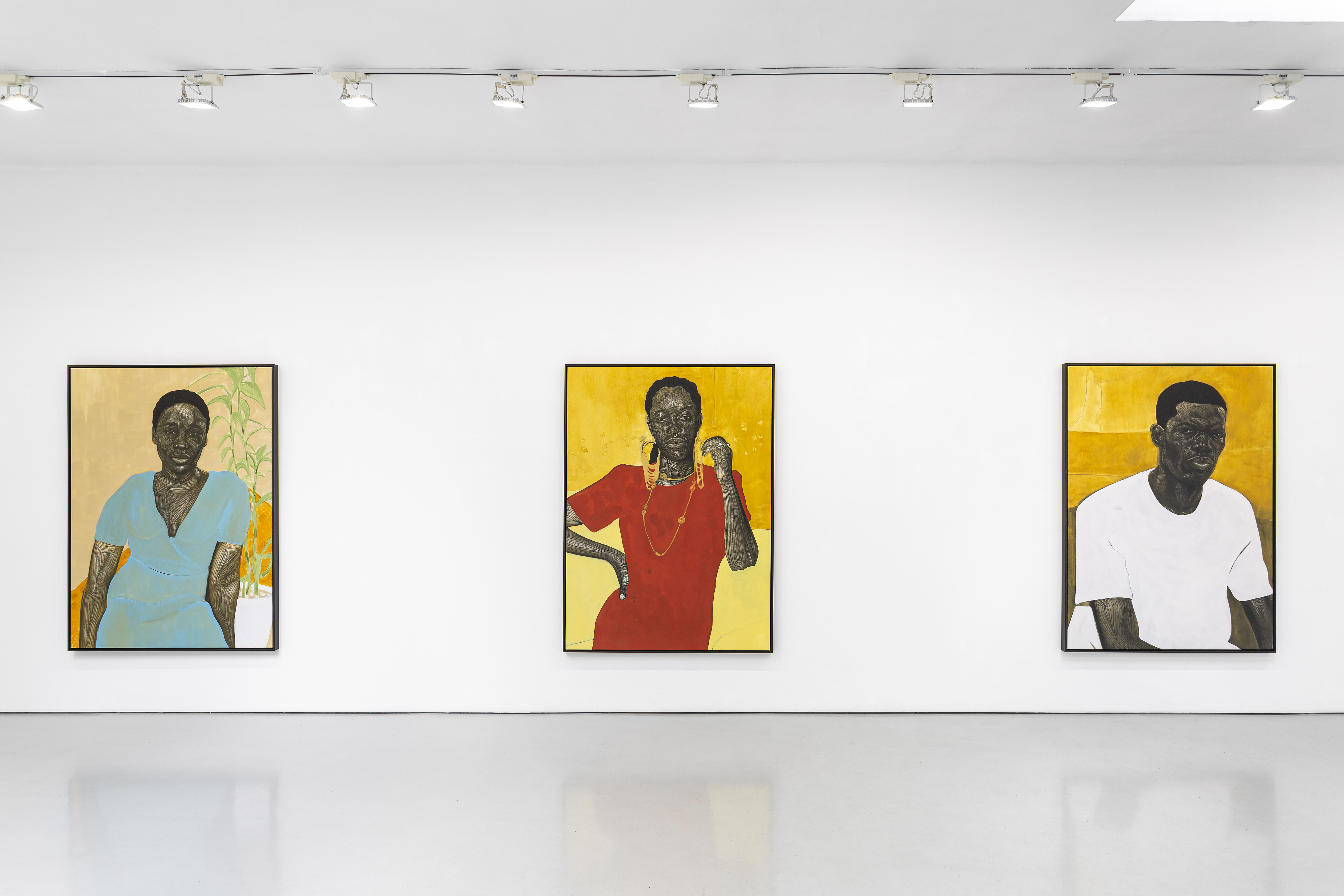
We are pleased to announce Traces of Me, the first solo exhibition for Collins Obijiaku with Luce Gallery. A series of new portrait paintings - all with his signature meandering charcoal line-work - will be on view beginning May 4 through July 21, 2023.
Obijiaku is a Nigerian-based painter who uses the tradition of portraiture to examine the depths, truths, and complexities of humanity. In each work, the artist paints quiet, composed figures, with expressive gazes, to directly engage the viewer. To further strengthen the allure and intimacy, Obijiaku draws a winding line—with no detectable beginning or end—that weaves throughout the sitter’s face and skin reminiscent of ‘mapping’ each person’s life journey. Together, the paintings in Traces of Me encourage viewers to contemplate the individuality of each person, as well as their distinct contribution to the diversity and complexity of the human experience.
This exhibition brings together a collection of portraits of people the artist has known since childhood. As the title Traces of Me hints, the paintings conceal a small element of the artist’s connection between him and each kindred spirit on view, a sentiment Obijiaku felt after working on the series. In every elegant composition, he observes an old friend, memorializing their likeness, and thoughtfully records their inner conviction of strength, hope, positivity, and intelligence. Although usually indifferent to incorporating symbolism into his work, his use of ochre yellow, in many of the paintings, references the artist’s nostalgic connection to the hue from childhood. He recalled that all the brightest students were selected for the yellow group — a color he still associates with intelligence to this day. While aesthetically pleasing, the true strength of Obijiaku’s work is how he marries observations of each sitter’s distinct mannerisms and expressions, with his meditative charcoal line work, to gently guide the viewer to see more deeply and encourage profound empathy.
In Portrait of Gladys (woman in blue dress) we see an elegant, young Nigerian woman donning a periwinkle blue dress. In a pale yellow room, she sits with her arms pressing downward, shifting her weight slightly left while leaning ever-so-slightly forward toward us, meeting our gaze directly. There’s a brief pause in her expression — her eyes slightly squinting— as if she’s examining us, rather than the other way around.
Her demeanor is calm and poised, while simultaneously exuding an inner confidence. For Obijiaku this confidence is particularly important to emphasize with his female sitters, as he seeks to change common misconceptions of women, and instead emphasize their power. Meandering throughout her face, across her chest, and cascading down each arm, Obijiaku’s signature charcoal lines create visual pathways for the viewer to explore. Working much like fingerprints or wrinkles, the lines identify her, as well as all the twists and turns of life. She knows who she is, where she’s been, and where she aspires to be.
Collins Obijiaku (b.1995) is a Nigerian-based visual artist working in portraiture. A self-taught painting and drawing artist, Obijiaku creates alluring portraits of individuals from his home country. In each work captivating gazes and skin permeated with charcoal line work resembling topographic maps, foster a deeper understanding of both the individual, and ultimately humanity as a whole. In 2019, Obijiaku was an artist-in-residence at Black Rock Senegal, the multidisciplinary residency program founded by artist Kehinde Wiley in Dakar, Senegal. Obijiaku’s works have been also exhibited at the Museum of African Diaspora in San Francisco and the National Gallery of Arts in Enugu in Nigeria. His international exhibitions throughout Africa, Europe, and the United States include a solo show with Roberts Projects in Los Angeles, California. Additionally, his work has been acquired by numerous private collections and public institutions, including the Dallas Museum of Art in Dallas, Texas.
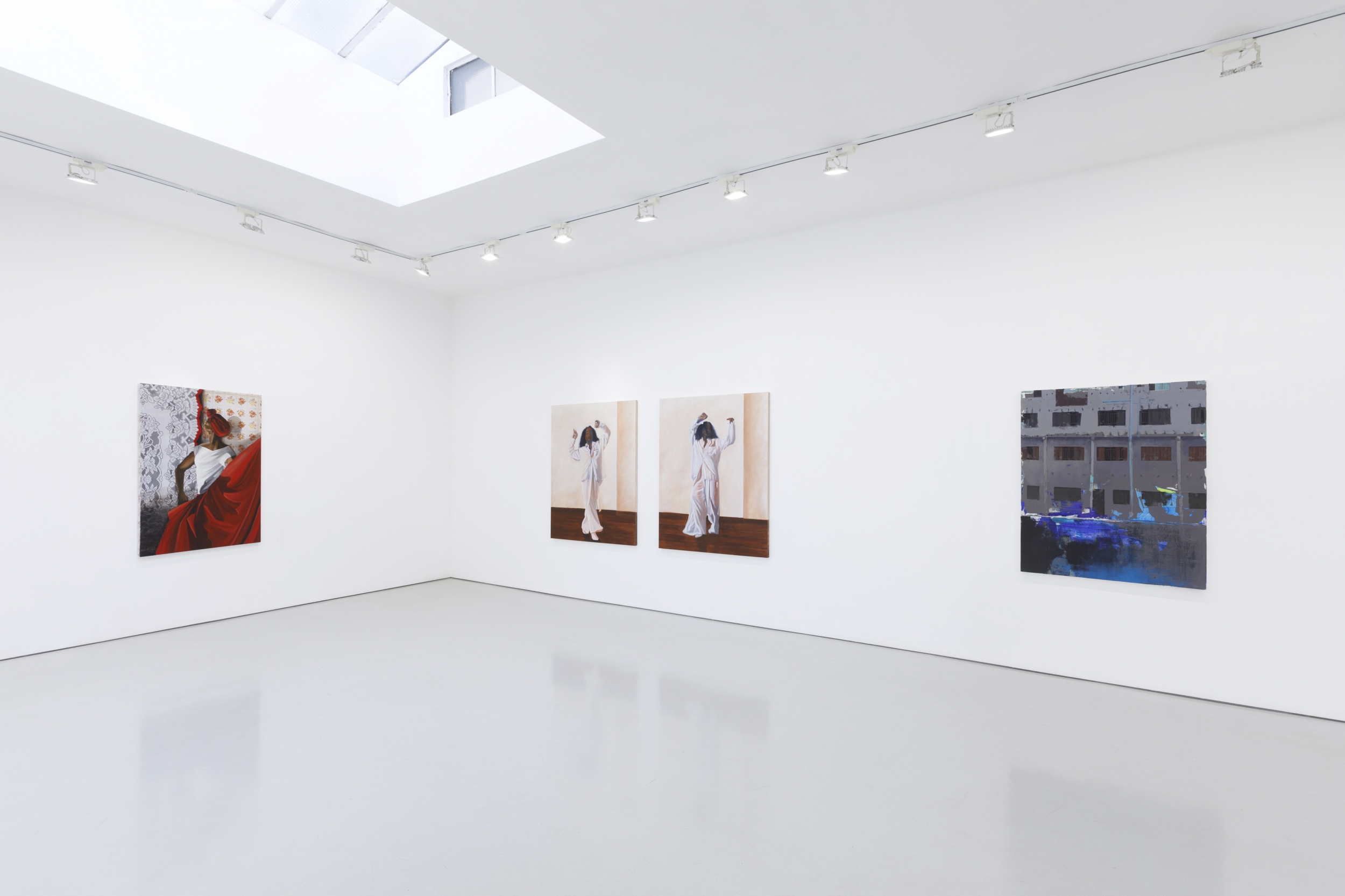
Luce Gallery is pleased to announce The Dance, a group show featuring Kika Carvalho, Danielle De Jesus, Yaya Yajie Liang, Emmanuel Massillon, Pedro Neves, Thomias Radin, Austin Uzor, and Sydney Vernon, in Turin from March 16 to April 28, 2023.
Bringing together fifteen artworks, including painting, drawing, and sculpture, The Dance embodies the rhythmic movements - both literal and metaphorical - of dancing styles. Deeply embedded in our cultural histories, the expressiveness of movement relates to celebration, ritual, or simply a distinct pattern or tempo. Each artwork on view addresses the various art historical connections, abstract qualities, or symbolic references to dance in the visual arts. The exhibition seeks to explore the myriad ways in which contemporary artists can interpret, layer, or reconsider this classic subject matter. The dynamism of movement, elegance of patterns, graceful steps, and rhythms of ancestral rituals have provided inspiration to artists for centuries.
In Danielle De Jesus’s Bomba Combativo (2023), a graceful young woman twists her torso, swinging her full scarlet petticoat using Bomba movements. This traditional Puerto Rican dance can trace its roots back to enslaved peoples from Africa and indigenous Taínos tribes. As this type of dance is still performed today, it creates a deeply rooted connection to Puerto Rico’s ancestors and becomes a source of pride and defiance against the colonists who tried to erase their traditions.
Sydney Vernon's Musical Chairs (2023) and Kika Carvalho's Summer Birds They Sing Their Song I and II (2023) also question the dialogue between body and sound and dynamism in space and time. The first, a graphite drawing on paper, focuses on the freedom of movement of a group of people who enjoy playing musical chairs in a scene of leisure outdoors. The two paintings portray the same young black woman, just awake, in a fluid and unpredictable sequence of dance following the birdsong.
The influence of dance is not however limited to the human figure and may often refer to rhythmic or lyrical movements. In Pedro Neves’s diptych, Movement 1 and 2, we see streams and waves of thin lines cascading downward against blue backgrounds meant to represent rainfall. In Movement 1, these lines tap the rooftop, as we imagine them “dancing” across the surface, drumming to nature’s beat.
Nocturnal atmospheres, in which the breath of the wind waves the sea surface in Thomias Radin’s Danse Nocturne (2023) and sways the curtain on the window in Austin Uzor’s Drifting Hibiscus (2023), evoke the floating dimension of dreams.
Dance can also be symbolically representative. A common idiom called “the dance” refers to when we engage in a negotiation of conflicting priorities where balance, skill, and meticulousness are crucial to success. In this sense, many of the works included in this exhibition could reference any number of contemporary conflicts from our everyday relationships to race relations.
In Emmanuel Massillon’s Dog Food (Water Hoses and Fire Trucks) (2022), we see two large ferocious dogs leaping to opposite sides of the canvas ready to attack against an abstracted background of blue, gray, yellow, and red. This scene brings to mind the painful history of civil rights protesters in the 1960s, when police used dogs to attack those who demonstrated peacefully. Here the negotiation between two groups is complex, aggressive, and unfair, leaving viewers to question - how do we even begin to engage with such impossible conflicts?
We can find other affinities between dance and art in the reiterated physical movement of the hand that determines the pictorial gesture, as expressed by Yaya Yajie Liang's Echoing in Time (2023). Masses of color expand on her canvas like sound waves, suggesting rhythmic melodies.
When contemplated as a whole, the artworks in this exhibition express what it means to see, feel, and experience “dance” in contemporary visual art today.
Kika Carvalho (1992, Vitória, Brazil) is a Rio de Janeiro-based visual artist working primarily in painting. Carvalho’s artistic practice and research center around the color blue which recalls both her relationship to her homeland and the history of painting.
Danielle De Jesus (1987, New York, United States) is a Queens-based Nuyorican painter and photographer. Her work is informed by personal experiences with gentrification and displacement in her hometown of Bushwick and encourages rumination about the negative effects of capitalism and colonialism present in urban America.
Yaya Yajie Liang (1995, Henan, China) is a London-based painter. Often pulling inspiration from other artistic sources such as literature and cinema, her works are studies on momentary sensation, perception, storytelling, and materials.
Emmanuel Massillon (1998, Washington D.C., United States) is a Washington D.C. and New York-based African-American conceptual artist. Working across several media, including painting, photography, sculpture, mixed media, and installation, Massillon explores the complexity of race, identity, and culture while fostering conversations about politically charged topics and realities of daily life.
Pedro Neves (1997, Imperatriz, Brazil) is a Belo Horizonte-based visual artist working in painting, sculpture, and photography. His work stems from the need to rethink the history of Brazil by increasing the representation of traditional cultures and daily family life, while simultaneously confronting issues of colonialism and imperialism that still plague the country.
Thomias Radin (1993, Les Abymes, Guadeloupe) is a Berlin-based painter. With a background as a curator and artistic director of dance, Radin’s artistic practice equates the movement and feel of dance with the process of painting, referring to it as an “intuitive freedom of expression”.
Austin Uzor (1991, Nigeria) is a New York-based painter and drawing artist. His work explores the “unknown” by examining psychological spaces, feelings, and alternate realities in search of existential truths, often focusing on the traumas related to displacement.
Sydney Vernon (1995, Prince George’s County, Maryland, United States) is a New York-based visual artist working across multiple types of media including painting, video, and performance. Her practice is heavily inspired by her family history, Black-American culture, and in-depth investigations of self.
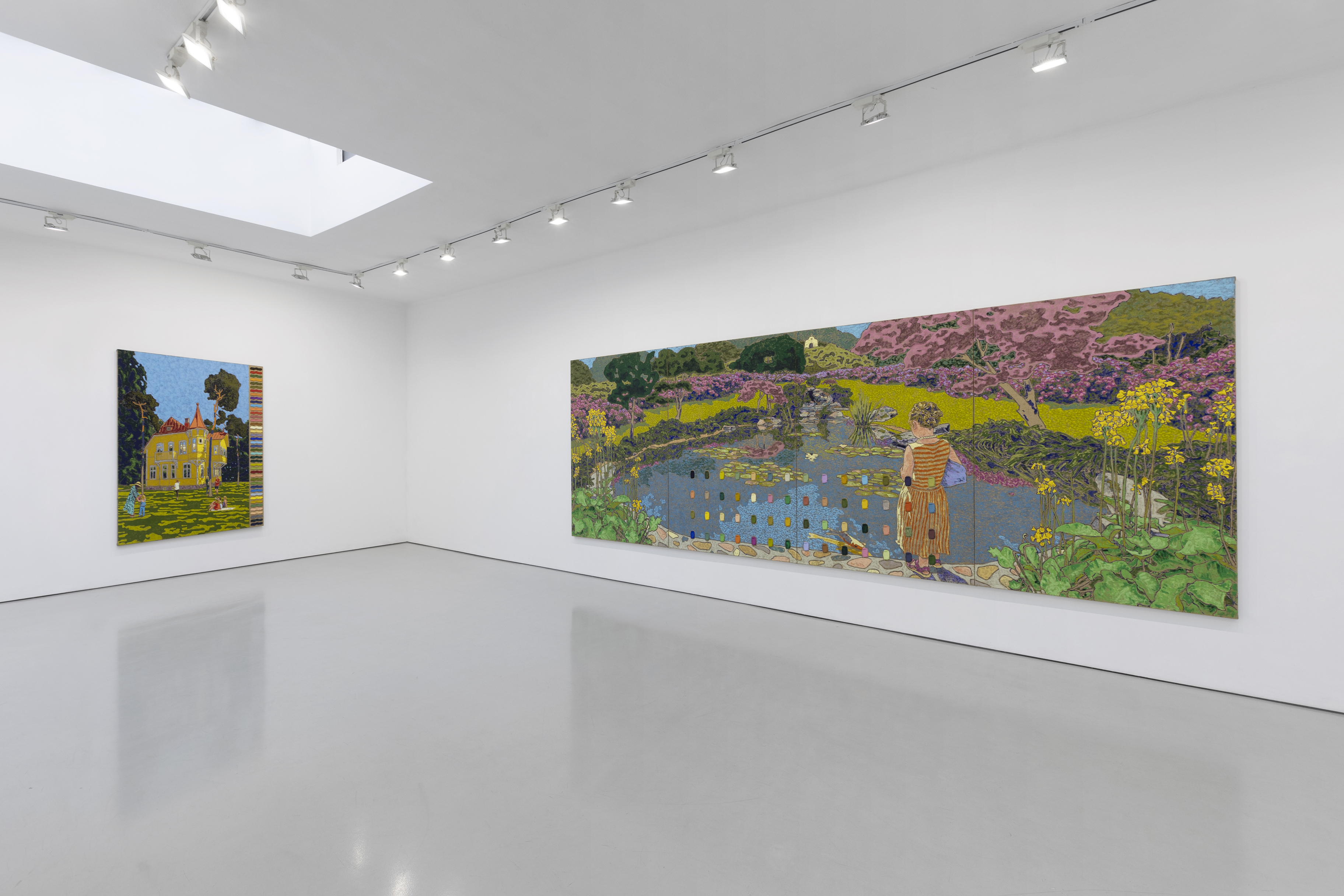
Luce Gallery is pleased to present Parklife, a solo exhibition of new works by Swedish-born and Norwegian-based painter, Peter Mohall. Twelve paintings — all with his signature cast brushstrokes highlighting the painting’s palette — will be on view beginning January 26th through March 2nd 2023.
Mohall creates post-impressionistic style landscapes dotted with people enjoying moments of leisure and tranquility. Inspired by Swedish and Norwegian coastlines and countrysides, Mohall documents his observations while on holiday with friends and family. When translating these subjects into paintings, he embraces surfaces like jute which emphasizes texture, and rich palpable colors that simulate a luminosity from within. Uniquely, Mohall also invites the viewer into his artistic process by sharing each color from his palette painted on acrylic casts, and neatly stacked or arranged in the composition. The artworks on view in Parklife cleverly pair the beloved picturesque traditional landscape genre with a distillation of the painting to its most simplistic form, the colorful brushstroke. Here viewers are simultaneously encouraged to experience both the transportative nature of landscapes, and to contemplate the complexity of how each abstract element that composes the painting — the colors, lines, gestures, and forms — contribute to these emotional experiences.
The exhibition’s title, Parklife, is borrowed from the 1994 British rock band Blur’s title track song of the same name. Much like Mohall’s paintings, the songwriter explained his upbeat, spoken word song was “about the park class...having fun and doing exactly what you want to do.”
For this series, Mohall instills an en plein air feel to his paintings by referencing photos from past trips that he digitally collages. From there he later creates detailed-to-scale studies on paper of both the scene and a color index reference before beginning the final painting on jute or linen. Working with tempera grassa, the artist mixes pigment-rich paints that resemble saturated jewel tones in his paintings. After a color is used in the composition, he then paints one of his cast brushstrokes the same color and affixes it to the painting’s surface. For Mohall, the replicated artist’s brushstroke investigates the importance and authenticity of the artist’s hand or recorded gesture in the painting — does repetition change the meaning? The strength of Mohall’s work is its grounding in abstraction; there is always an emphasis on color theory, form, texture, and spatial relationships that enlivens his compositions.
In his large two-panel painting, I Nores Hage (2022), we are welcomed to a red cliffside home and surrounding property with sweeping vistas of the turquoise seaside below. Tall thin trees reach up toward the crystal blue sky filled with pale pink and lavender fluffy clouds. In between the trees five figures, perhaps family members, stand on the sun-kissed chartreuse and shady mossy lawn all gazing in different directions. Each seems to enjoyably take in another part of the epic view standing as upright, still, and almost meditative as the surrounding trees. On the left of the work, the artist has stacked all fifty-three hues used to create the painting, a reminder to the viewer of the complexity and diversity of colors used in the large work. Yet it is ultimately up to the viewer to decide if they choose to dwell in the landscape or contemplate how it was created. “Confidence” is after all “a preference for the habitual voyeur.”
Peter Mohall (b. 1979) is a Swedish-born, Norwegian-based artist working in painting. His work is an exploration of the history and medium of painting as a subject. Mohall graduated from the Oslo National Academy of Fine Arts. He has exhibited throughout Europe, Asia and the United States, including solo shows with Koki Arts (Tokyo), Pablo’s Birthday (NYC) and QB Gallery (Oslo). He has also participated in a number of art fairs including, Felix Art Fair in Los Angeles, CA; Untitled and Art Basel Miami in Miami, FL; and Dallas Art Fair, in Dallas, TX. Additionally, his work has been acquired by numerous private collections as well as public commissions in both Oslo and Drammen.
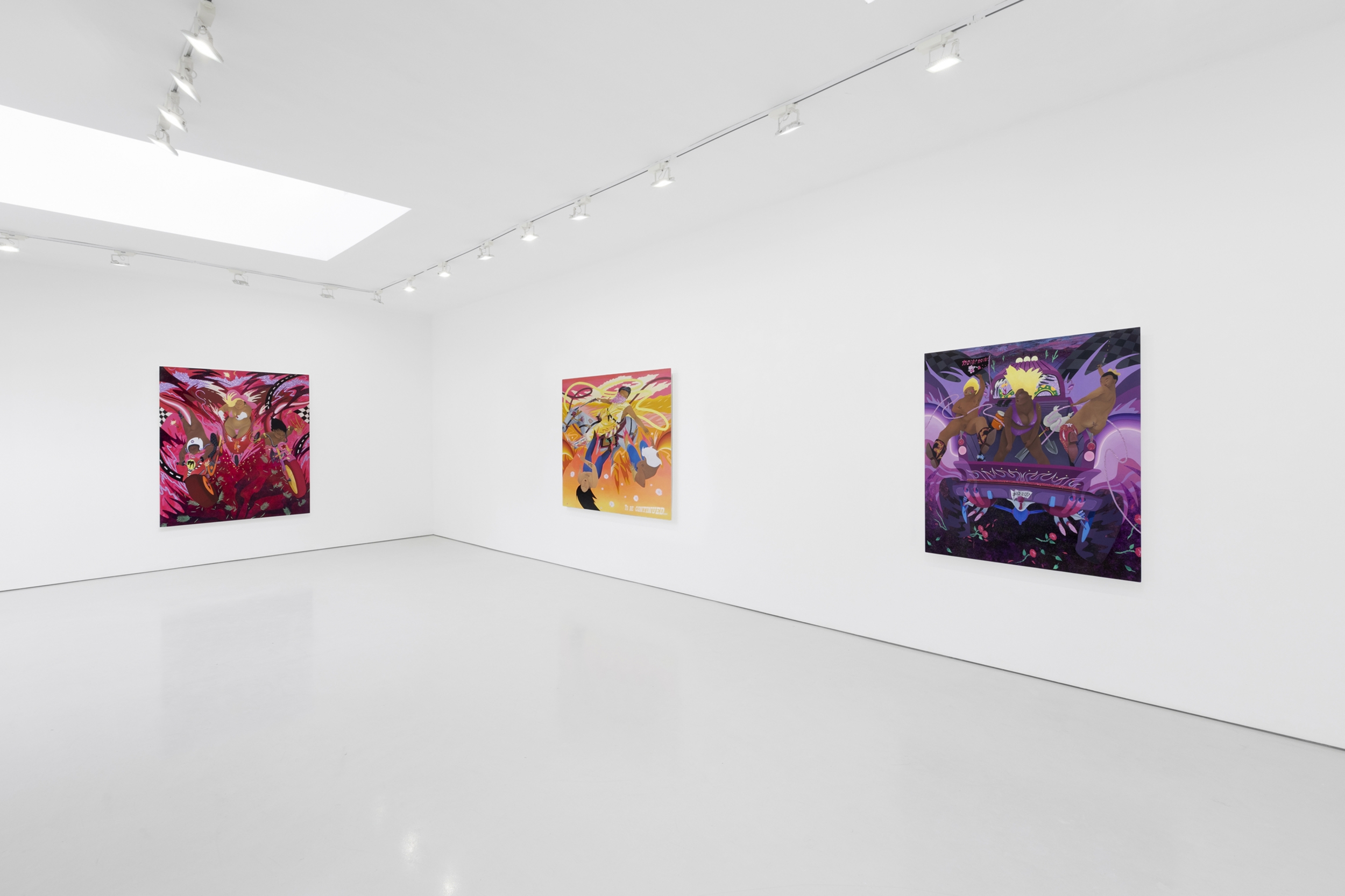
Luce Gallery is pleased to present Eye Become the Beholder, the first solo show by Yowshien Kuo in Europe. The exhibition will be on view from December 15, 2022, to January 20, 2023.
Kuo is a St. Louis-based painter who incorporates Asian-American figures into surreal landscapes with American Western undertones that aim to communicate universal experiences through narrative and curated symbolism. His lauded technique of fine brushstrokes that resemble a smooth, matte air-brushed appearance, are contrasted with sandy surfaces of glittery lines and eye-catching reflective crystals. Each of Kuo’s paintings are layered with symbols that embrace multi-faceted interpretations from both Eastern and Western traditions, a practice that also reflects his personal experience. When viewed together, the paintings presented in Eye Become the Beholder, invite viewers to witness the figure’s fantastical desires, while simultaneously encouraging deeper introspection about what differentiates our sense of “reality” from fantasy, or fact from fiction.
The exhibition’s title, Eye Become the Beholder, is a poetic rewrite where the word “I” is replaced by its (English) homophone word “eye”. In this context, the artist is emphasizing that individuals will become what they observe, and in this instance the observations are our unavoidable social desires of love, acceptance, and belonging. In this series, the Asiatic figures explode into the scenes surrounded by splashes of color, with abstract backgrounds embracing flannel patterns, star-filled galaxies, and monochromatic rainbows. Here, each work reads like an action film sequence, focusing on the satisfaction and immediacy of the film’s climax as the protagonist suddenly and boldly appears front and center. Each of Kuo’s paintings is an invitation down the rabbit hole to experience a version of reality that exists between the celestial and terrestrial realms, haloed by medieval mandolas. The strength of Kuo’s work is the seamless pairing of his meticulous painting skill with his mesmerizing commitment to symbolic and narrative details that confront preconceived notions of Asian- Americans.
In Paper's Orgasmic Promise of Gold (When Icarus does not fall) a nude statuesque cowgirl hitches a ride atop a jet-fueled moped racing through a foreboding crimson landscape. She stands confident, unflinching, and gazing straight ahead, moving at a speed that has blown her red cowboy hat clear off her head. In her right hand she commands a golden lasso over her head, while her left hand rests just at her pelvis with her arm’s coiling snake tattoo suggestively moving downward. She appears almost goddess-Iike in both her confidence and in her command over this modern chariot. In the distance, we see the silhouette of a city left far behind in the moped’s exhaust. Scattered in the foreground we see torn aces and joker playing cards, perhaps inspiring the title’s reference to the allure of gambling. Other details, however, seem to point to the consequence of this vice with multiple references to death with gravestones, ritual incense, and flaming Joss paper or “afterlife money.” Have we been guided to the land of the dead at full speed or are we simply offered a fleeting glimpse of this reality as a cautionary tale?
Bio
Yowshien Kuo (b. 1985) is a St. Louis-based artist working primarily in painting. His work blends his personal experiences as a Taiwanese American with historical references and criticism to comment on social and racial inequality, cultural constructs, sexuality, and the human condition. Kuo graduated with an MFA in 2014 from Fontbonne University in St. Louis, Missouri. Most recently he was the recipient of Great Rivers Biennial Arts Award 2022-23, having a solo exhibition at The Contemporary Art Museum in St. Louis. His artwork has also appeared in many publications including New American Paintings #149 in 2020, where he was prominatley featured on the cover. Kuo has exhibited throughout the United States and Europe, including a number of art fairs.
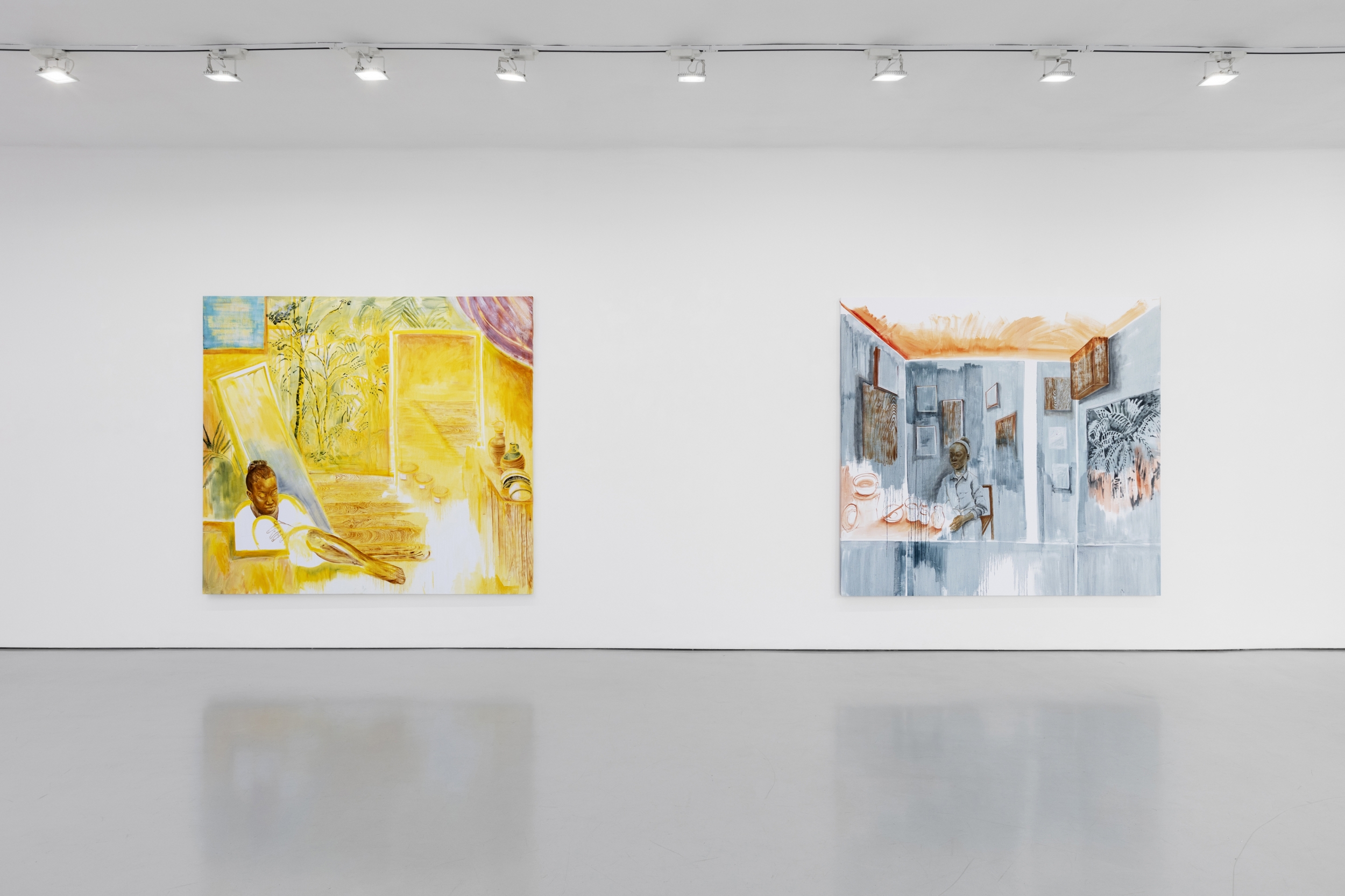
We are pleased to announce, Memory Palace, the first solo exhibition for Johanna Mirabel at Luce Gallery, on view beginning October 6 through November 18. Mirabel is a Paris-based painter who incorporates pensive figures into dissolving, dream-like interior spaces. By combining symbolic hues, tropical plants, household objects, and suggestions of exterior spaces with detailed portraits, the artist creates deeply intimate works that explore the immersive and transportive experience of recalling a memory. When viewed together, the paintings presented in Memory Palace pose deeper questions about how our memories can simultaneously coexist and conflict with our history, cultures, and even identity.
The exhibition’s title, Memory Palace, references the Method of Loci, a memory strategy that uses visualizations of a space well-known to an individual, to aid in their recollection of information. The idea is that you can mentally walk through your familiar space or “memory palace” and look at your memories to recall them more efficiently. For the artist, these familiar comforting spaces are the interior rooms of a home. In her own interpretation of a “memory palace,” Mirabel reveals the psychological process of how we recall and experience memories by juxtaposing elements from the exterior world with our interiors spaces. Each painting illustrates how some details — like ocean waves or a breeze through palm trees— are recalled more vividly than others, understanding that our memories work less like pristine photographs and function more like fragments of images, sounds, feelings, and tastes.
In the context of Mirabel’s paintings, memories seem to be a combination of both personal recollections and taught experiences of historic or cultural traditions — all that have shaped her identity and journey. Her brushstrokes — often loose, gestural, and painterly — are used to simply imply an object or area. By contrast, the artist creates realistic portraits of her sitter’s faces who are typically friends or family, including herself and her twin sister, Ester. Each has a detailed somber expression — capturing a moment of deep thought or reflection. Similarly, there is also a great deal of care and detail incorporated into the floor, with the wood grains aptly articulated to lure the viewer’s eye. For the artist the meaning is two-fold, the flooring references the lumber industry for French Guyana and reminds her of visiting her relative’s homes there. Tropical house plants are also incorporated into her compositions with reversed light and shadows adding to the mystery of what is part of the space and what is part of the vision. The artist uses a bright palette of cerulean blue, red ochre, golden yellow, and burnt sienna, inspired by both Guyanese Tembé traditions and their rich red clay earth.
Mirabel’s diaphanous washes of colors, dissolve the physical barriers between interior and exterior spaces, and, instead emphasize the “veil” between them. The strength of Mirabel’s work is how she captures the transition between two distinct states —of physical and mental —and challenges the viewer to decipher which details and symbols belong to the memory and which belong to the present.
In Living Room n° 23, we see a suggested room captured in monochromatic red ochre with hardwood flooring and a collection of tropical houseplants. On the left, a woman is slouched in an unseen chair. Her legs and arms crossed, her shoulders slightly shrugged. She gazes downward, but is not fixated on any object. Instead, her solemn expression seems to confirm that she is lost in thought, perhaps on the one being conjured just behind her. Surrounding the fence-like edges of the red interior space, are overcast clouds with hints of a cerulean sky beneath. Below the figure, the detailed floorboards activate the depth of the scene, creating an uneven perspective that appears to gradually lift upward and slightly curve, as if leading us towards something in the unseen distance.
Bio
Johanna Mirabel (1991, Colombes, France) is a Paris-based painter whose work explores the intimate connection between our inner thoughts and interior spaces.
Her work draws from her French Guyanese and Martinique-Guadalupe heritage, sociological and philosophical writings, and western art historical references. In 2019, Mirabel graduated from the prestigious L’ École Nationale Supérieure des Beaux-Arts in Paris. Since then, Mirabel has exhibited throughout France and internationally through numerous group shows and art fairs including: Dallas Art Fair, in Dallas, TX and 1-54 Contemporary in London, UK and New York, NY with Luce Gallery, where her work was acquired for notable private collections. Earlier this year she was the recipient of the 2022 Ritzau Art Prize, and will begin a prestigious residency in October at The International Studio & Curatorial Program (ISCP) in New York City.


