
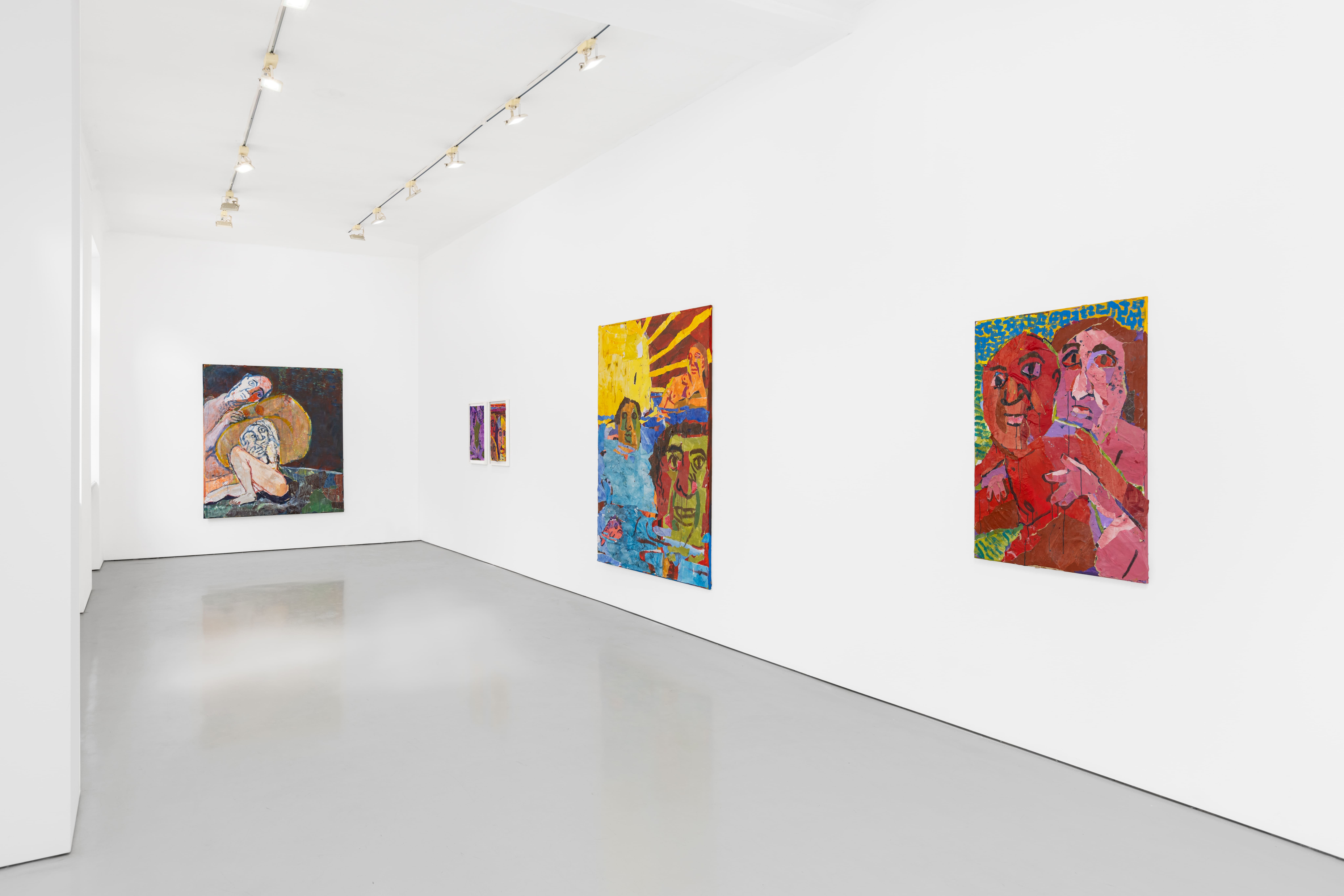
Luce Gallery is pleased to present Entangled Fragments, Shanee Roe’s second Solo Exhibition with the Gallery, curated by Luisa Seipp.
Fragments of paper accumulate across the studio floor, moved, layered, glued down, drawn upon or torn away again. “This is organised mess,” Shanee Roe says about the process behind her recent collages.
Moving from oil painting towards collage, Roe increasingly allows paper, colour and material to determine the image as it unfolds. Where earlier paintings often developed from drawings and were then translated onto the canvas, these new works resist any such predetermined path. Compositions emerge through this process of assembling and undoing and re-assembling.
This shift introduces a new meaning into Roe's figurative language. Her bodies no longer appear simply depicted but pieced together, their contours formed through cuts, ruptures and overlapping pieces of colour. A face, an arm or a torso might emerge from several independent fragments, the seams between them left visible. Collage thus operates beyond technique – it proposes the body as something relational, continually growing, something reconstructed rather than fixed.
The tension between separation and intimacy runs through all of Roe's work. Her figures touch, embrace, desire and seek one another, yet complete union remains elusive. Roe describes this recurring impulse as a longing for physical connection paired with an inability to ever fully merge. In the new collages, this tension becomes embedded in the very structure of the image – separate pieces meet and overlap without entirely surrendering their boundaries.
Water, recurring throughout her new works, seems to work against these edges. It becomes a blurry space of exchange, unsettling the distinction between interior and exterior, one body and another. Figures seem to enter or contain one another, their bodies becoming permeable while remaining distinct.
Alongside these familiar questions of intimacy and physical connection, another gesture has begun to enter Roe's images. Following the recent birth of her child, smaller bodies and three-figure constellations recur. Even though identifying them as representations of mother, father, and child, Roe understands them more as three souls tangled into each other. In one of her works, a standing figure holds a smaller body against their own while another kneels beside them. Rather than settling into recognisable familial roles, the image draws attention to the gesture itself of holding, supporting, carrying. Care enters alongside desire as another possibility for how one body might relate to another.
Tenderness, however, never resolves into complete comfort. Roe's figures retain something uneasy and ambiguous, resisting both fixed identities and stable relationships.
Perhaps it is precisely this refusal of resolution that connects Roe's new process to the relationships her images contain. Collage brings fragments into contact without requiring them to lose their wholeness. In the same way, the bodies in these works imagine intimacy not only through the desire to dissolve into one another, but through another possibility. Through a closeness that does not depend on becoming one.
Care may therefore mark the most subtle shift in Roe's recent work – not as an iconography of motherhood, but as an expanded understanding of intimacy itself. To hold, carry or support someone is to remain connected while still honouring their very unique wholeness. Like the fragments from which Roe's images are built, these bodies touch, depend upon and transform one another – however, their contours remaining, always, their own.
Dr. Luisa Seipp
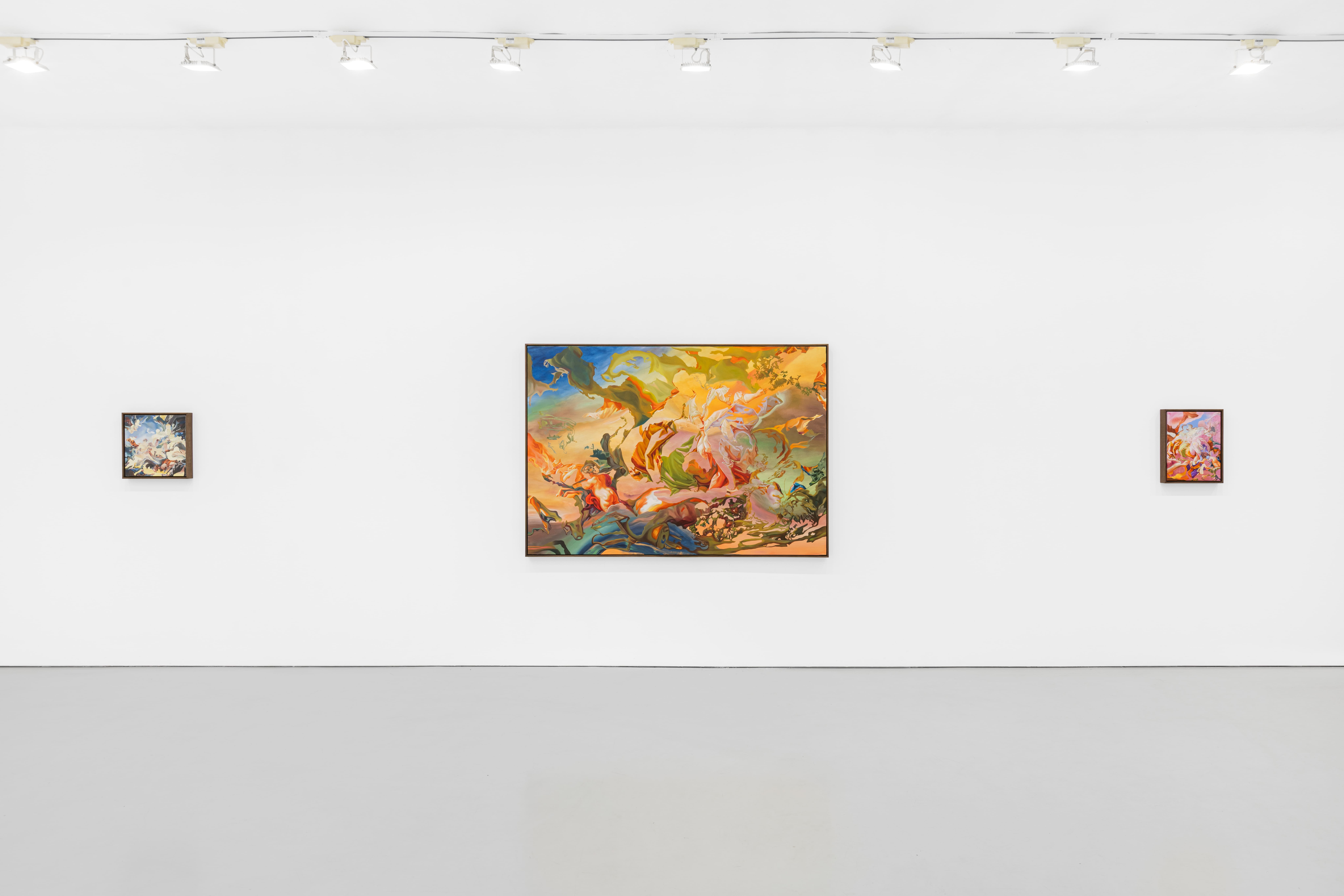
Luce Gallery is pleased to present E Ancora Primavera, Silvia Rosa’s first solo exhibition with the Gallery.
The exhibition brings together a new body of work in which painting functions as a device for the transformation of images. Through a process of accumulation, erasure, and reactivation, Silvia Rosa constructs a visual space where personal memory, the history of images, and the collective imagination converge within a pictorial materiality that is constantly being redefined.
The works emerge from the reworking of a vast personal archive made up of images collected, remembered, and preserved over time. What interests the artist, however, is not the recovery of these sources, but rather the process through which they are absorbed into the flow of visual experience until they lose their recognizability. The figures that inhabit the paintings gradually move away from their origins, entering an unstable dimension where individual memory and a shared iconographic heritage overlap and mutually contaminate one another.
Repetition, a central element in Rosa’s practice, does not coincide with the reiteration of the same. Rather, it becomes a tool capable of making visible the temporality of the image—its gradual transformation and its ability to move through different states and layers while preserving an internal tension.
Painting thus becomes a site where forms are subjected to continuous shifts. Figures, anatomical fragments, iconographic references, and fields of color emerge and dissolve within an open structure that is constantly being redefined. The image never appears as a finished form, but as a process unfolding across the surface of the painting, turning form itself into an organism in a state of continuous becoming.
At the core of Rosa’s research is the observation of the processes through which forms emerge, transform, and redefine themselves over time. In this sense, the repetition of forms and colors never amounts to the repetition of the identical; instead, it becomes a means of measuring the image’s ongoing transformation. The pictorial space takes shape as an open field in constant reorganization, where figurative and abstract elements coexist without establishing fixed hierarchies.
The viewer experiences a sense of familiarity that never fully translates into recognition. One moves through images that seem to evoke something known, yet continue to resist a singular interpretation. Figures, fragments, and fields of color oscillate between presence and dissolution, between what emerges clearly and what remains suspended. It is within this space of tension that painting finds its strength, inviting the viewer to engage not only with what is visible, but also with what remains open and undefined.
In this continual reactivation of the image, what once seemed settled and sedimented resurfaces in unexpected forms.
E Ancora Primavera does not refer to a season, but to a condition of perpetual regeneration. The images, bodies, and memories that inhabit these paintings never cease to transform, giving rise to new possibilities for connection and meaning. Like a bloom that continuously renews itself, each form contains the trace of what it has been and an opening toward what it may still become.
Biography
Silvia Rosa (Latina, 1998) lives and works in Milan.
In 2025, she received her Master’s Degree in Painting from the Brera Academy of Fine Arts in Milan, following her Bachelor’s Degree in Painting from RUFA – Rome University of Fine Arts in Rome, obtained in 2020.
Recent exhibitions and awards include Sguardi IV, Villa Giulia (Verbania, Italy); A Great Job, Kromya Art Gallery (Verona, Italy); Phänomenfarbe, Westend Galerie (Frankfurt, Germany); Premio Mestre di Pittura, Centro Culturale Candiani (Mestre, Italy); Sguardi III, Galleria L.U.P.O. (Milan, Italy); Premio Arte, Museo della Permanente (Milan, Italy); Summer Storm, Galleria Mimmo Scognamiglio (Milan, Italy); Malamegi Lab Art Prize Venice 2023, Imagoars (Venice, Italy); Mirabilis, Palazzo Meravigli (Milan, Italy); and Combat Prize, Museo Giovanni Fattori (Livorno, Italy).
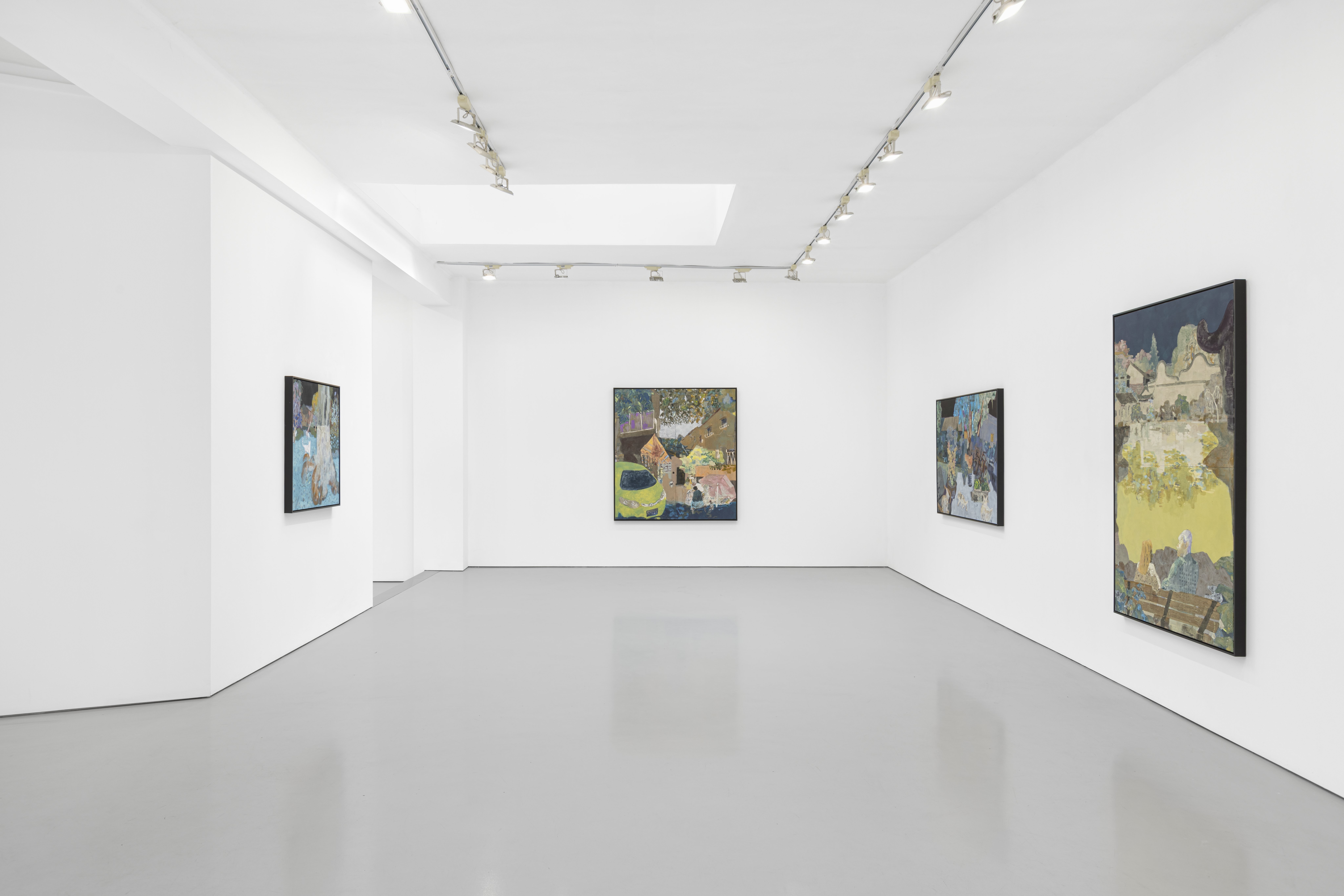
Luce Gallery is proud to present the first Solo Exhibition by Chen Tianyi, born in Nanjing, China, 1996 and living in Tokyo.
In “The Mayfly”, the Artist is presenting a series of new paintings in his first solo exhibition in Europe.
A brief, ephemeral flutter of wings sweeps through this exhibition, suspended between time and fading. The works move like memories surfacing in the mind's lanes, familiar yet unreachable. Here, the urban landscape is not a place but an emotional state, a labyrinth where the present bends to dream. Figures emerge and vanish, like memories that resist clarity. Painting becomes a threshold: between the visible and the invisible, between what has been and what could be. The artist constructs surreal metaphors that ask not to be explained, but to be traversed. Each canvas is a fragment of consciousness, an echo of experiences beyond words. In this space, the everyday is transfigured into vision. And the viewer is invited to lose themselves, as if in a memory that refuses to end.
"Wandering. Night-walking.
An uninterrupted overview of time.
On the streets of a foreign land, I imagine myself as a 'Mayfly' in the city—suspended between reality and dream, pausing at their intersection while searching for lost coordinates along ascending ramps. The granular mineral pigments (iwaenogu) I employ act both as debris of time and as anchors of memory. Through layering, grinding, and exfoliation, light and shadow are rendered almost eternal, completing a breath of existence that stretches across millennia.
Traditionally, the Mayfly—living at dawn and dying at dusk—has served as an extreme metaphor for transience. In my practice, however, this figure transcends its biological and poetic connotations to become an existential condition: a continuous, fluid rhythm of wandering and night-walking within the unfamiliar fabric of the city.”
Titled The Mayfly, the exhibition presents Chen’s recent investigation into the relationship between individual identity and urban space. Having lived abroad for many years, the artist does not experience wandering as rootlessness, but as a constant oscillation between reality and dream, the familiar and the estranged. This condition resonates with what he defines as an “Intermediate Area”: a liminal zone that is neither fully objective nor entirely subjective.
In these works, nocturnal streets, flickering lights, and intersecting ramps cease to function as mere visual subjects. Instead, they become psychological landscapes—stretched by time and filtered through memory. The materiality of mineral pigments, formed over geological epochs, enters into dialogue with the immediacy of gesture, generating a surface charged with tension. Each layer becomes a trace of the mayfly’s fleeting passage, recording a temporal structure of experience—what might be described as a continuous unfolding between retention and anticipation.
The Ramp series in the exhibition finds further expansion here. Through radical shifts in perspective, stable architectural forms reveal an inherent instability. This instability mirrors the wanderer’s ongoing negotiation of identity within a foreign cultural context. Through the lens of “anemoia”—a nostalgia for places never personally experienced—Chen constructs collective, imagined geographies across the pictorial surface.
“Although the life of a Mayfly is fleeting, its flight occupies space absolutely. Likewise, the solitary journey of the nightwalker encounters the density of time through movement.” Chen Tianyi invites viewers into a quiet nocturnal world composed of mineral layers, where ephemeral yet authentic moments of affect emerge—delicate, luminous, and transient, like the wings of a Mayfly. A confrontation with time. A return to the self.
Biography
Chen Tianyi (b. 1996, in Nanjing, China), lives and works in Tokyo.
He graduated from the Central Academy of Fine Arts as an undergraduate in 2018 and Received his MFA from Tama Art University and Tokyo University of the Arts in 2022 and 2024 respectively.
Recent Exhibitions include As I walked out one evening (Hive Center for Contemporary Art, Shanghai, China, 2025) and Structure of the landscape (Gallery Binosha, Tokyo, Japan, 2023), Skipping Stones (Union Pacific, London, UK, 2026) Will+s Vol. 9, (SOGO Museum of Art, Tokyo, Japan, 2025).
The Mayfly is his first Solo Exhibition with Luce Gallery.
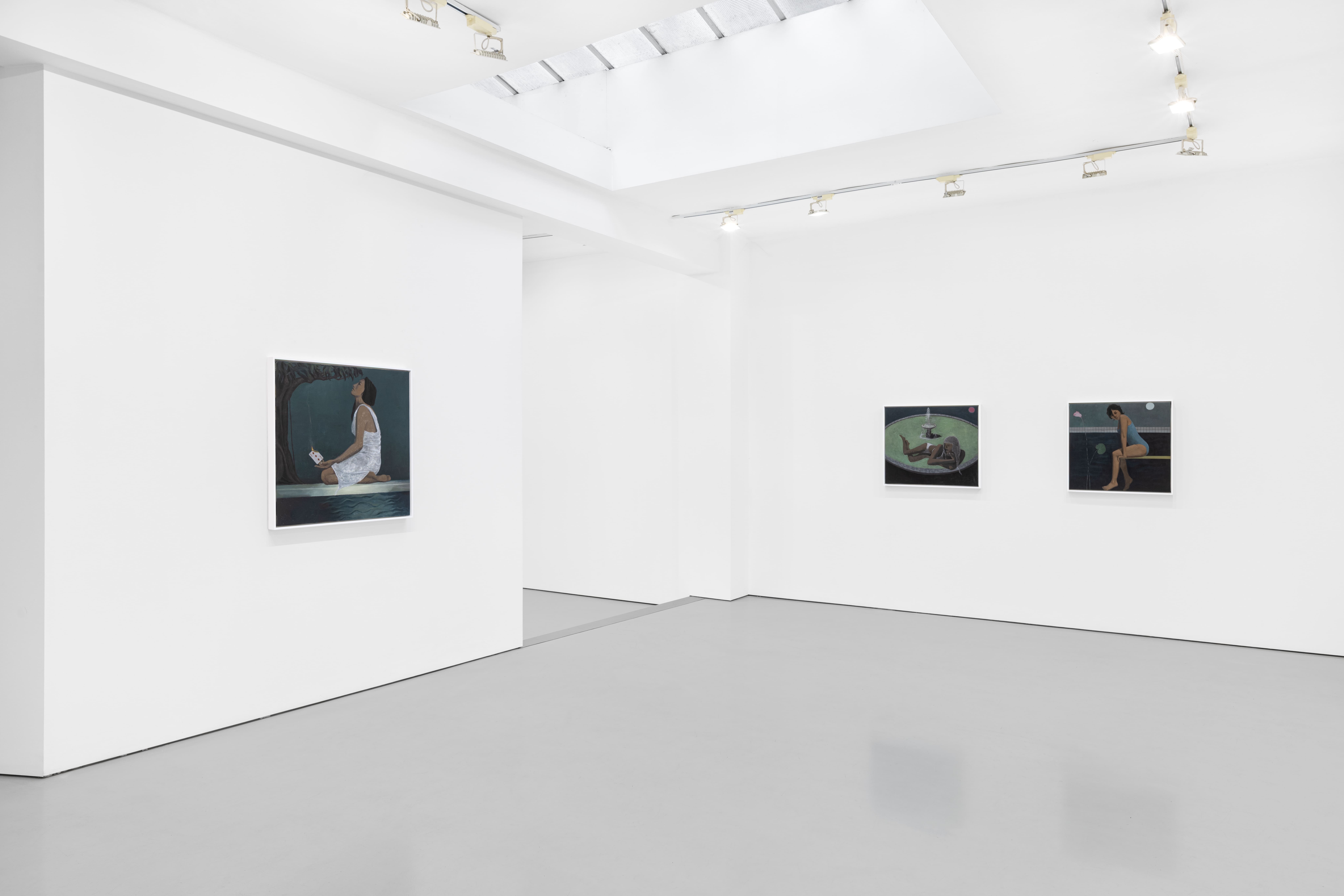
Luce Gallery is pleased to present Liu Xin’s first solo exhibition, a series of works that traverse the unstable territory of dreams, memory, and the unconscious, giving form to an intimate and psychological mode of painting.
I Had the Same Dream as Freud is situated within Surrealist research, focusing on the exploration of the inner landscape of human nature. Through a layered visual language—where figures, symbols, and environments intertwine organically—the works investigate universal themes such as love, loneliness, and existence, rendering them within a dimension suspended between reality and dream.
Liu Xin develops her works from personal dreams, understood not as simple dream narratives, but as sites where hidden impulses and deep emotional truths emerge. Within these suspended imaginaries, characteristic of the dream experience, the human figure appears isolated and absorbed, often captured in moments of pause or waiting. The settings—rarefied domestic interiors, empty swimming pools, uninhabited seascapes, or natural landscapes—are not merely backdrops, but extensions of the figures’ emotional states. Recurring symbols such as apples, swimming pools, beds, sofas, and trees assume a metaphorical function, alluding to desire, loss, memory, and the fragility of being. Each work seems to contain an inner temporality, as if the action were suspended at the precise moment when thought takes precedence over gesture.
Following the path traced by Sigmund Freud in The Interpretation of Dreams, Liu Xin deconstructs the unconscious dynamics that inhabit the dream experience, blending them with symbolic elements drawn from Greek mythology. The result is a dialogue in which fragments of the subconscious and mythological archetypes overlap, generating a spiritual resonance capable of transcending temporal and spatial boundaries.
The choice of lighting, dominated by dark tones and muted colours, helps to evoke the unstable and nebulous quality of dreams, visually translating the subtle and often contradictory emotions that inhabit the subconscious. Within this visual space, the sense of destiny characteristic of Greek mythology encounters the deep currents of Freudian thought: latent desire, submerged loneliness, and existential questioning are transformed into an intense, restrained, and deeply meditative pictorial language.
Bio
Liu Xin is a Chinese artist, born in Weifang, Shandong Province, in 1996. She graduated from the Experimental Art Department of the Xi'an Academy of Fine Arts in 2021 and obtained her Diploma from the Intermedia Art Department at the same academy in 2024.
Liu Xin lives and works in Xi'an, China.
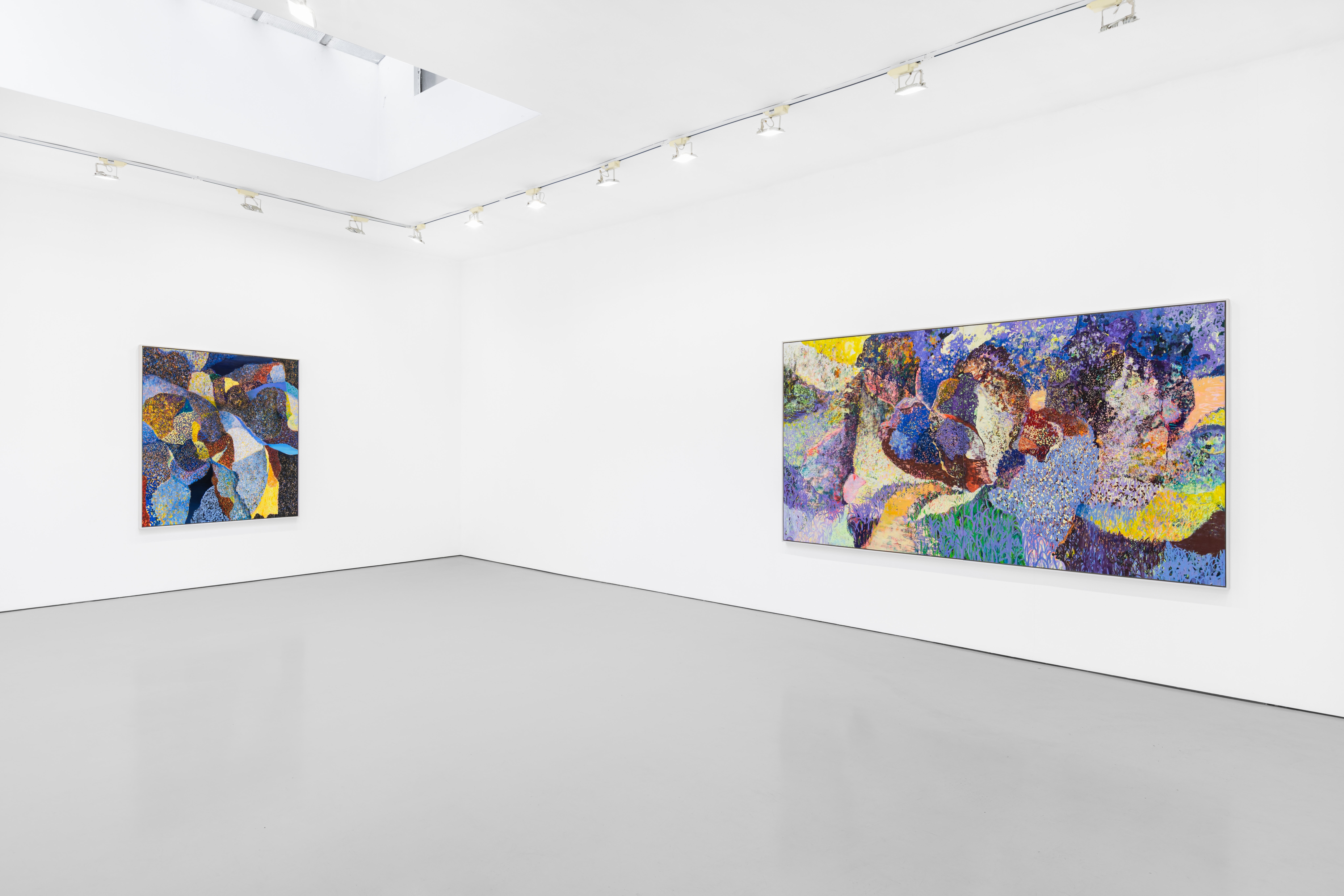
Luce Gallery is proud to present the second Solo Exhibition at the Gallery by Connie Harrison.
In Wanderings, large-scale panels invite viewers to immerse themselves in her visual realm, while also magnifying tiny details from the more-than-human world beyond the recognisable. Her work touches on both the power and the fragility of the environment, speaking to a sense of nature as simultaneously allencompassing and vulnerable, and inviting a reassessment of the complex relationships between self and other, person and place, and abstraction and figuration.
Harrison begins each composition with a base layer of a bright colour, which will sing through the subsequent layers. She then adds a layer of clear wax before painting in a linear representation of her first compositional element, which is generally the form of a leaf of flower, a tiny detail of a landscape magnified to fill the picture plane. After another layer of wax, she adds a contrasting composition which intersects with the first, spatially segmenting the canvas with two images that together dissolve into near-abstraction.
She then begins to add layers of paint using pointillist or impressionistic brush techniques, often in earthier or more autumnal colours. This muddies or grounds the original fresh base shade, which nevertheless continues to shine through vibrantly like light wherever she scrapes back into the surface, which she does with a scalpel between coats of paint. There is an ongoing process of covering and uncovering at work in which colour plays a key role, turning the complex composition into a multiplicitous and yet harmonious set of relations.
Harrison’s process has sculptural elements to it, particularly where she scores back into the paint to reveal underlying lines and colours, anchoring and unifying the work. She sees herself as carving a wandering path through her painterly surfaces, seeking a route among the textures and hues of the image. This is echoed in the experience of viewing the work, in which the eye is led into the expanse of the picture plane and taken on a journey in many directions at once, replete with shortcuts, dead-ends, and re-emergences. Throughout these prismatic paintings, there is an elision of the distance between foreground and background, playing with the traditional spatial rules of painting, unfolding into multifaceted organic geometries. Despite being landscape-like, the works eschew a horizon line or central vanishing point, eluding definitions of scale; these could be close-ups of a garden border or views of the earth from far above, as romantically intimate as they are distantly topographical.
These paintings require extended looking; details and relationships emerge they longer they are observed. Harrison is interested in inviting viewers to consider alternative viewpoints, something that is echoed in her own process of turning the works upside down during her painting process in order to gain a different perspective on the composition. There is a tension at play within this body of work, between light and dark, foreground and background, vibrancy and quiet; constantly unfolding into further complexity, her dynamic paintings have an ungraspable quality, as though hovering just out of reach between figuration and abstraction.
Bio
Connie Harrison (b. 1993, UK) is a British artist who lives and works in London.
She graduated with First Class Honours in Fine Art from Chelsea College of Arts, London, in 2016, after completing a Foundation course at New College Nottingham.
Recent exhibitions include Strata Nino Mier Gallery New York, 2025, Fifteen Years Luce Gallery, Turin, 2024, Phantasmagoria IBF Contemporary London, 2024, New Now Guts Gallery London, 2024, Bloomscapes Luce Gallery Turin, 2024, and Reverdie Arusha Gallery Edinburgh, 2023.
Wanderings marks her second solo exhibition with the Gallery.
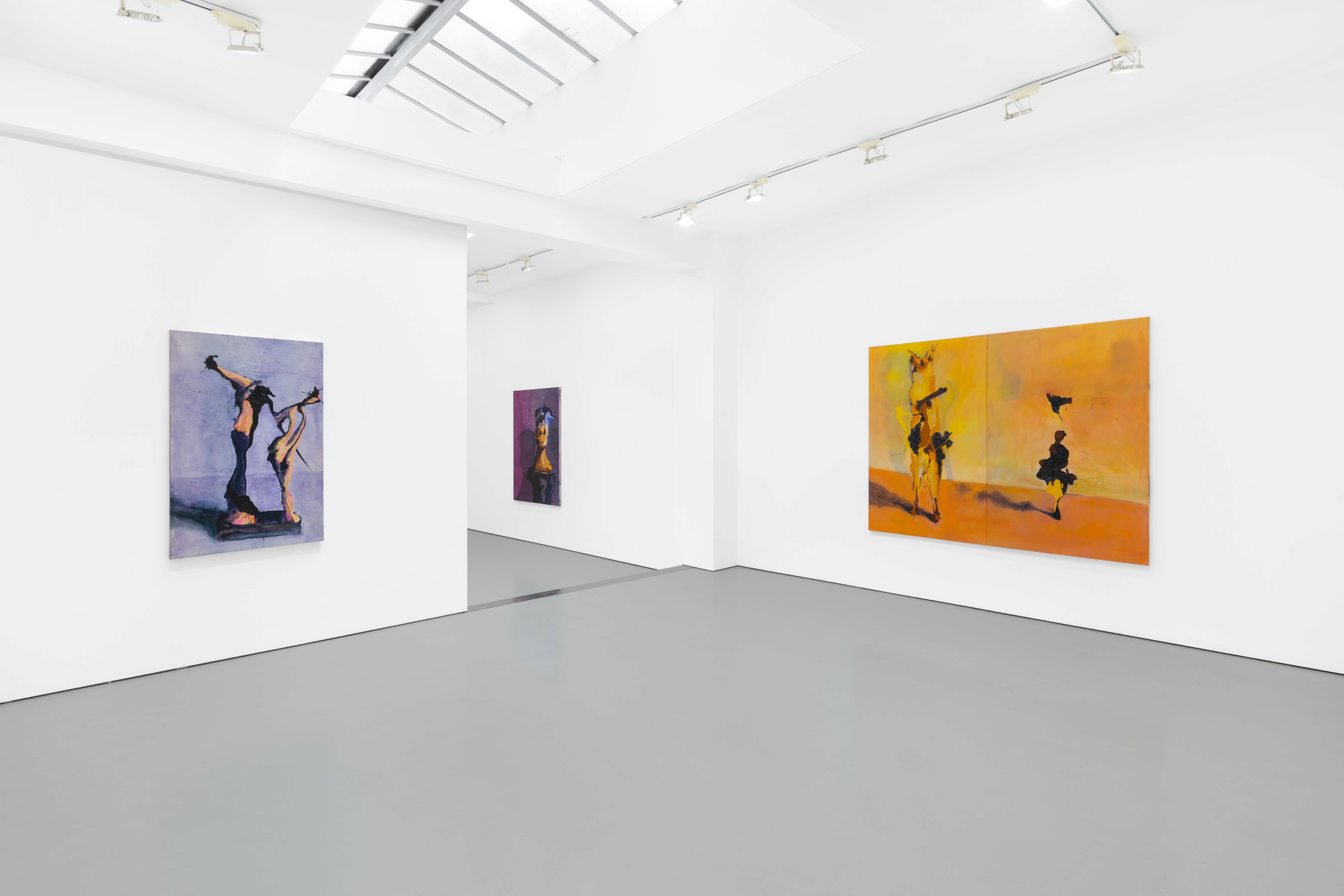
Luce Gallery is proud to present ‘Hansel, Gretel and Barbie on a Bike’, a solo exhibition by Michael Alexander Campbell (b. 1999, Cambridge, England; lives and works in New York).
The works present a cast of characters, blending mythical and contemporary cultural figures, where both the likes of the Pied Piper and Barbie appear. Some of these myths are updated and invite new interpretations: Queen Nefertiti seems to be wearing sunglasses, and Lady Godiva is dressed in fine garments.
The Dusk of Downtown
by Hannah Wikforss-Green
Manhattan becomes a necropolis in August. Much of what you see, hear, and feel outside consists of the drip-drop, white-noise acrid heat plume blasting from AC units hanging by a thread out of tenement windows; the streets are emptied by provincial deserters and by locals retreating to the cooler confines of their walk-up apartments. Your sweat smells like deli meat and cigarettes, and you crouch in front of the cold fridge light which illuminates your kitchen at 5 a.m., cooling yourself off with leftover lo mein while trying to counter martini-induced dehydration with tepid $1 Poland Springs. But for me, the memory of the thick, hot air of summer 2023 is cut through with the noise of Michael Alexander Campbell clinking Bob Dylan’s Ballad of a Thin Man on the grand piano on the second residential floor of Julian Schnabel’s big pink Palazzo Chupi on West 11th Street.
I met Michael that summer, when he was working on huge psychedelic-looking paintings in the basement garage of Palazzo Chupi. Large canvasses laid unstretched on the floor, and colorful slashes of oil paint made out abstract shapes that somehow invited you into a world which was both strange and familiar. He would eventually be employed by Julian as well, and we quickly became friends, matching each other’s ability to spew rambling non sequiturs and indulging a shared obsession with various cultural scenes throughout New York’s history. We both lived Downtown – Michael in the East Village, I on the Lower East Side – a 20-minute walk door to door.
Michael came to New York at a peculiar point in time, painting against the backdrop of a strange culture. I call the years between 2022 and 2025 in New York the “intercrisis period,” the brief intermission between the pandemic and Trump 2.0. New York, a city known for being a progressive oasis in an increasingly nationalist United States, has not remained unaffected by political developments. Downtown – particularly around my immediate area, which some refer to as Dimes Square –suddenly seemed overrun by crypto-worshipping groypers who had appointed themselves standard-bearers of a new, post-woke literary and artistic subculture that had emerged during the pandemic.
Nestled on the border between Chinatown and the Lower East Side, Dimes Square has come to be known as a physical place as well as a subculture. Division Street dead-ends into Canal Street – a diagonal exception to Manhattan’s otherwise iconic north-south, east-west grid system – creating a triangular square filled with outdoor seating belonging to various bars and restaurants. The area is known for its exquisite cash-only $4 dumpling joints, bodegas with scratch-off lottery tickets as well as fake diamond-studded dildos, and voluntarily starving, unbearably hip, irony-pilled writers and artists with a penchant for coining provocative slogans.
When Michael was new to New York, I would schlep him around to various readings, openings, and parties in Dimes Square. We went to The Shop, right at the foot of the rust-colored Williamsburg Bridge on Delancey Street, a sort of blind pig saloon that doubled as the headquarters of an insect extermination business, seemingly ripped straight from William Burroughs’ Naked Lunch. Late nights were spent in Chinatown and Little Italy at pop-up parties with Catholic converts in constant conflict with most of the seven deadly sins. At Sovereign House, down the block from my old apartment, you’d be assaulted with information on the blockchain by extremely wealthy crypto dudes financing readings for poets exploring reactionary themes. We didn’t like the politics, but we liked that there was a scene.
Michael treated his apartment as if it were a hotel room, spending most of his time either roaming the cracked sidewalks of Downtown or working on large canvases on the black-painted rooftop of his Avenue B apartment building, where he stored his paints and brushes in a treasure chest. If I wanted company, I knew he wouldn’t be far off. We’d head to diners early in the morning, share a plate of pancakes, and revel in that solemn conviction that we were experiencing the nexus of some sort of something.
Michael would constantly collect images, which he continues to use as reference material to this day – reworking and reinterpreting them in paint, abstracting the visuals while preserving their general form and composition. His camera roll is filled with photos of the city, tchotchkes he spots in antique shops, and screenshots of things and people on Instagram (…and sometimes even Hinge…).
His method of collecting and storing reference material is uniquely contemporary, yet the way he synthesizes it pays homage to the greats of the past.
2022–2025 felt like the last iteration of Downtown – the dusk of a culture that had always existed in Manhattan south of 14th Street and north of the Financial District, one that Michael and I managed to catch just as it was coming to an end. With dramatic cultural and political shifts in the U.S., and the cost of living rebounding to even greater heights after the brief period of cheaper rent during the pandemic, I became acutely aware of the impermanence of this scene – and of Manhattan’s ability able to host any scenes at all.
Only time will tell what the lasting legacy of the Dimes Square scene will be, but its quality as a playful (if occasionally sinister) force – experimenting with high and low, social media-and-internet themes, and irony – has left an indelible mark on the artists like Michael, who spent some of their formative years bopping between readings and gallery openings within that physical and cultural geography.
Bio
Michael Alexander Campbell was raised in Switzerland and studied Fine Art at Lancaster University in England before apprenticing with Julian Schnabel in New York. His large-scale oil paintings distort photographic sources until only their essential composition remains. What persists is the narrative, evoking myths and fairy tales where stories endure even as characters shift and fade. Campbell’s exhibitions include group shows and residencies across Europe and the United States, as well as his first solo exhibition at Casa del Popolo in New York (2025). His work is luminous and vibrant, combining gestural, expressive marks with precise, classical brushwork to produce paintings that seem at once punk and traditional.
“Ultimately, if you know what meaning you are trying to suffuse into your paintings before you make them, they will be either didactic or unoriginal. The meaning will be there whether you like it or not.”
.jpg)
We are pleased to announce The Branch Will Not Break, the second solo exhibition by Yowshien Kuo with Luce Gallery. Opening September 11, the show presents a selection of new paintings.
“In the new year, I began each morning looking back on the nostalgia of my earliest painting lessons. I reached for materials first introduced to me as a young art student in Taiwan – bamboo and mop brushes, black ink, rice paper, and water. Recruiting the philosophical and physical antecedents of a calligraphic discipline. Various ratios of water and ink permeated, glided, and blotted the underweight paper – an improvisation. Messy and wet, a guided but liberated unpredictability of heavily saturated achromatic depths, inkblots, solidified into surreal landscapes of roaring clouds, laser horizons, and wild flora. The result of these studies shared a communal dialogue with Chinese Tang Dynasty paintings, whose influence is notably evident in the shared cultural hybridity of 18th-century Literati paintings that bridged Chinese and Japanese values. Literati painting has its origins in China, and can be translated as scholar painting. It is more interested in personal erudition and expression than in literal representation by encouraging spontaneity as a virtue of sincerity. Facing an expanding and modernizing Western world, the orthodox literati style was no longer tenable, yet it did not disappear. Rather, it adapted, always refashioning itself. Subsequent iterations are multifarious and complex. So capacious is the discipline, my appetite for nostalgic musings is imbued by the wayward ink and cultural hybridity of the literati approach.
Weightless bamboo brushes sodden with ink, the mighty gossamer paper transcending through time, culture, and geography. Attuned to the perennials of calligraphy, landscape, flora, fauna, and the collaborative pedigree synonymous with literati painting. Transported, I awoke, squinting up at the chinks of beaming sunshine, listening to the susurrations of wild grass and the sweet, earthy scent of petrichor. An elusive cafuné is tender and gentle in my hair and at my fingertips. The directives and coarseness of the quotidian world are absent in these idylls. Here, I can claim this respite as my own; in this temporal order, skeleton keys are done away with, for doors with keyholes do not exist in the celestial manifestations of the mind. Unbounded, I can sense an archaic past and simultaneously an enduring future.
When clouds flower in the light of one’s own mind, to traverse in the inner landscape amidst the new demands and mandates that whittle reality becomes a rare and necessary inversion. Cynicism is easy; hope is challenging. Wayfaring through the milieu, flustered by lost door keys, the footing is mercurial and precarious, so I reach for the branch that will not break; trust is sturdy and stronger than it often appears. Relying on the muscle of self-introspection granted to me by the cosmos to recalibrate the tale told by an idiot. Gazing upward in ascension, I am warmed by the horizon and unfettered by the walking shadow beneath me; an abjection of the sound and the fury of the modern world. Emboldened by literati acumen, I peer through the looking glass, refashioning myself to grasp and embrace. As God’s finger gives life to Adam, I imagine him awakening from emptiness and saying, “…My God – It’s full of stars!”. As nature is beholden to humankind both in the eyes and in the mind, anything and anyone I touch can be a steadfast branch”.
Yowshien Kuo (b. 1985) is a St. Louis-based artist working primarily in painting. His work blends his personal experiences as a Taiwanese American with historical references and criticism to comment on social and racial inequality, cultural constructs, sexuality, and the human condition. Kuo graduated with an MFA in 2014 from Fontbonne University in St. Louis, Missouri. Most recently he was the recipient of Great Rivers Biennial Arts Award 2022-23, having a solo exhibition at The Contemporary Art Museum in St. Louis. His artwork has also appeared in many publications including New American Paintings #149 in 2020, where he was prominatley featured on the cover. Kuo has exhibited throughout the United States and Europe, including a number of art fairs.
Notes
The information on Literati artwork comes from the book, “Literati Modern”, Bunjinga from Late Ado to Twentieth-Century Japan. The Terry Welch Collection at the Honolulu Academy of Arts. Paul Berry and Michiyo Morioka. Published by Honolulu Academy of Arts. 2008. Along with references by China Online Museum, “Literati Painting”. https://www.comuseum.com/painting/schools/literati-painting/ and “Landscape painting in Chinese Art”, Department of Asian Art. October 1, 2004. Metmusuem.org.https://www.metmuseum.org/essays/landscape-painting-in-chinese-art.
The word cafuné is Brazilian-Portuguese (pronounced / ,ka-fu- ‘ne /). The website languagedepartment.com describes cafuné as, “…a force of affection, of tenderness, but most importantly it's a calming force…”. https://languagedepartment.com/beautiful untranslatable-words-from-around-the-world10/.
I am deeply moved by the phrases “Clouds are flowering” and “The is the light of the mind”, which both come from Sylvia Plath’s poem, The Moon and the Yew Tree, dated October 22, 1961.
The phrase “…celestial manifestations” comes from Nathaniel Hawthorne’s novel, The Scarlett Letter, 1850.
“The Branch Will Not Break” is the title of a poetry collection by James Wright published in 1963 by Wesleyan University Press. This collection is often considered a new direction for Wright. “…encompassed a startling mix of careful detail and surprising leaps of thought and structure in loose and open verses.” – https://poets.org/book/branch-will-not-break.
The lines, “creeping in this petty pace from day to day”, “The tale told by an idiot”, and “sound and fury” come from Macbeth’s speech: “Tomorrow, and Tomorrow, and Tomorrow” by William Shakespeare’s play, Macbeth. Ref. https://www.poetryfoundation.org/poems/56964/speech-tomorrow-and-tomorrow-and-tomorrow.
“Through the Looking Glass” is a book published by Lewis Carroll in December 1871, a sequel to Alice’s Adventures in Wonderland. The theme of his imagined entering into a strange new world was an inspiration to me in this work.
The image I had in mind for the description, “God’s finger gives life to Adam,” is none other than Michelangelo’s fresco referred to as The Creation of Man in the Sistine Chapel, c.1508-1512.
The phrase, “My God – it’s full of stars!” Caught my attention in Tracy K. Smith’s poetry collection, Life on Mars, published in 2011 by Graywolf Press. The author notes, “The title 'My God, it’s full of stars' is adapted from the quote from Arthur C. Clarke’s novel, 2001: A Space Odyssey…” This enhances the lines for me as I am inspired by Stanley Kubrick’s film of the same title as the novel. The themes of time travel and our relationship to the cosmos are congruent with the exhibition.
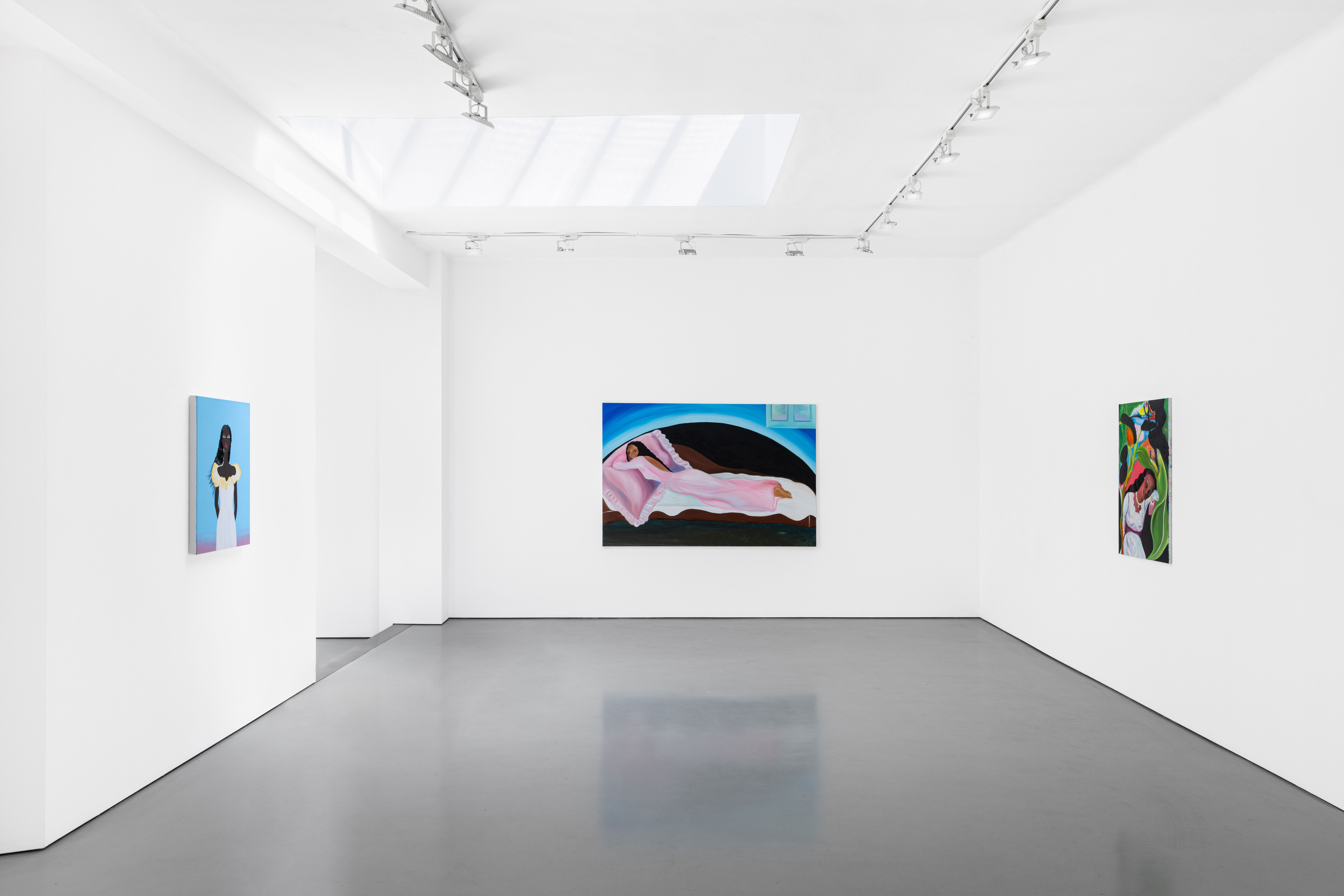
We are pleased to announce Refuge Poétique, the long-anticipated second solo exhibition by Delphine Desane with Luce Gallery. Opening July 16, the show presents a selection of new paintings and an installation that recalls the environment of the artist studio. Deeply autobiographical and brimming with iconographic details, each painting addresses relationships—with herself, her son, and her grand return to her native France. The work displays the artist’s new appreciation for hue, depth, and extended narrative while maintaining her popular elegant portraiture motifs. Viewed collectively, these paintings radiate a colorful ‘warmth’ and offer poetic reflections that feel both deeply personal and universally resonant.
A French phrase, Refuge Poétique translates to “poetic refuge”, referring to a tranquil place of solace where the mind can escape daily hardships through poetry— or in this instance, the poetic qualities of painting. As this solo show marks a pivotal stylistic shift in Desane’s practice, the title aptly describes her personal desire to create a haven for deeper introspection—one that explores the layered dimensions of identity and legacy within the context of her rich heritage. The show serves as a lyrical and aesthetic summation of her recent emotional and intellectual journey.
Her compositions, once characterized by stylized figures and abstracted landscapes rendered in a restrained Fauvist palette, now adopt a more realistic approach. Naturalistic portraiture, shading, and volumetric depth define this new phase, alongside detailed symbolism and iconography drawn from personal memories, spiritual symbolism, and cultural heritage. From the traditional compositions of Virgin and Child in Christian iconography to vivid chromatic harmonies reminiscent of the post-impressionist Paul
Gauguin, the artist has sought out traditional French references to embrace a more expressive visual language to better communicate the complexity of her emotions on canvas.
This shift was shaped in part by her relocation from New York City back to Paris. While living in New York, Desane was drawn to the minimalism of Donald Judd and Isamu Noguchi—an aesthetic that mirrored her pandemic-era experience of urban solitude and provided visual relief from the challenges of co-parenting and fast-paced rhythms of city life. For Desane, emotions needed to be conveyed simply, distinctly, and efficiently on canvas. In contrast, her return to Paris prompted a deeper reconnection with nature, culture, and memory. The resulting works lean into organic form and layered narrative, moving away from
minimalism toward intimacy, fullness, and self-reclamation.
In Sleeping Beauty—one of the show’s most emblematic and arresting paintings—a woman in elegant repose appears in slumber, her head resting gently on her arm. Behind and surrounding her, a lush mango tree unfolds into a dreamscape where a distant French provincial home emerges. Within this imagined world, layered symbols reflect Desane’s ideal sense of ‘home:’ the mangos, a staple on her Haitian-immigrant family table; a peacock, a common sight in French parks; an airplane overhead, alluding to her proximity to an airport and current day job; and blooming cherry blossoms, a nod to her fascination with Asian aesthetics. Solid black biomorphic shapes call to mind the surrealist forms of Jean Arp, whose work she regularly seeks out on museum visits. Painted in rich, tropical hues, Sleeping Beauty radiates ‘warmth’—a home-like sense of comfort that Desane seeks both personally and within her practice.
Dreams, a recurring motif in her oeuvre, here become more vivid, grounded, and reflective of her present interests. Here, the viewer is invited to explore this inner landscape, and in doing so, consider their own dreamlike escapes of ‘home’.
The strength of Desane’s artistic practice lies in its fearless openness to journey inward. Her work is a site of self-exploration—a space where the complexity of identity as well as its internal and external judgment are exposed for all to contemplate. She dares to expand her identity beyond simplistic labels and embrace its layers and constant state of flux by conveying a more personal message through her paintings. By confronting these themes in a visually lush, symbolically rich language, she not only poses existential questions for herself but also creates space for viewers to contemplate their own interior lives and perhaps the ways they are perceived by others. In this way, her work forms a Refuge Poétique—a place of rest for the soul amid life’s perpetual reckoning with identity.
Delphine Desane (b. 1988, France) is a painter and sculptor whose portraiture interweaves autobiographical elements of identity such as motherhood and Black womanhood within broader diasporic narratives of African and Caribbean heritage. A self-taught artist, she rose to prominence after her work appeared on the cover of Vogue Italia in January 2020. Her work has since been exhibited internationally, including at Canada and Pace Gallery (New York), Taymour Grahne (London), PENSKE Projects (Los Angeles), and Luce Gallery (Torino). Her paintings are held in the collections of the Studio Museum in Harlem, the Museum of African Contemporary Art Al Maaden (MACAAL) in Marrakech, and numerous private collections across Europe and the United States.
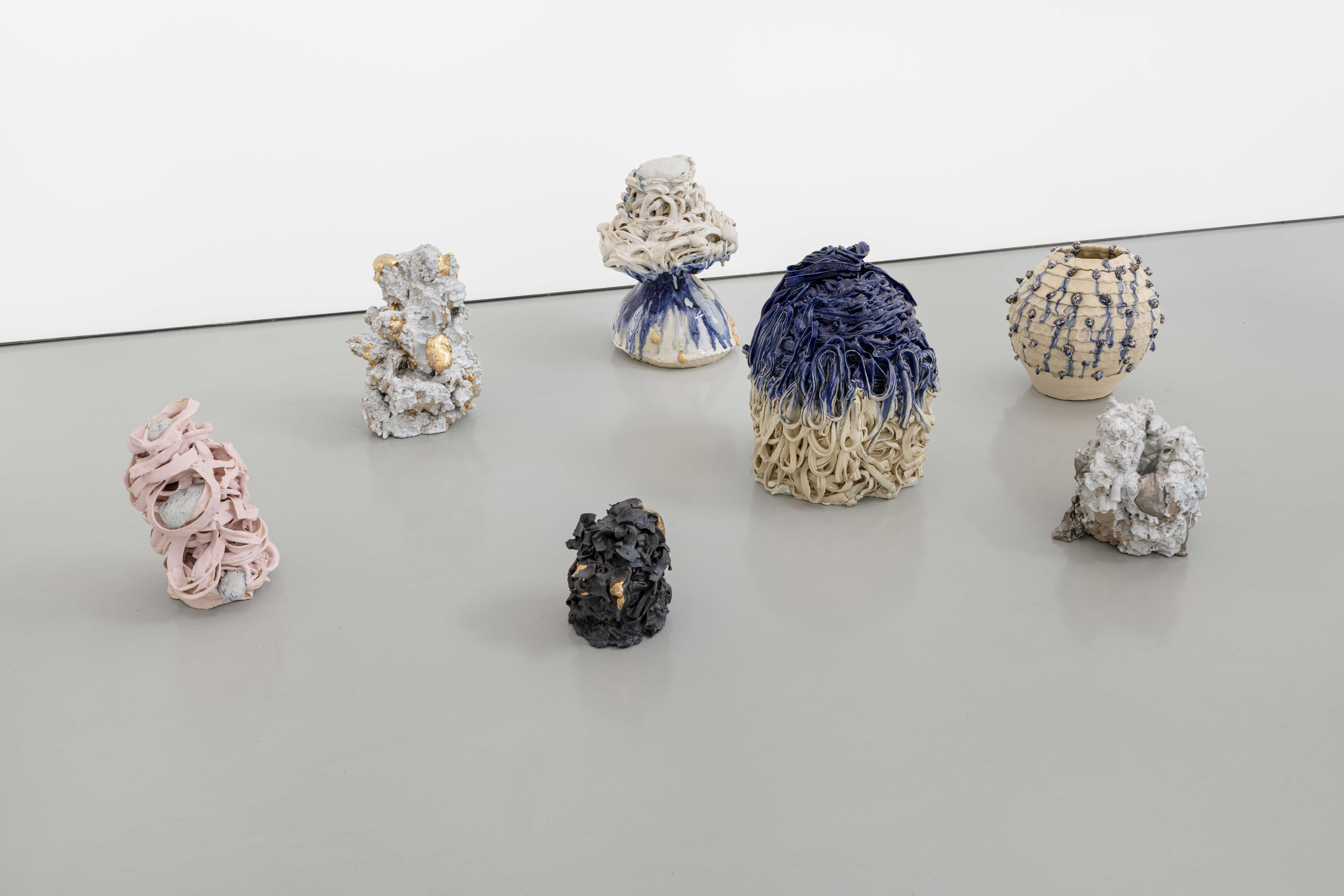
We are thrilled to introduce Nobuhito Nishigawara, debuting his first solo exhibition with Luce Gallery Qualia. Opening May 8, the show will display unique ceramic artworks, including a custom installation conceived specifically for the gallery space. Deeply conceptual and autobiographically, each intricate work reads like a visual diary entry, capturing moments of deep introspection in elegant forms. By combining advanced ceramic techniques, Nishigawara translates personal spiritual and mental relationships of change, reflection, and neutrality into alluring physical vessels rich in texture and hue. Viewed collectively, the detailed sculptures in Qualia create a mood-altering state of calm, inviting viewers to pause, observe, and—ideally —learn more about themselves through their unique reactions to each work and its spatial placement.
Both the series and exhibition title, Qualia, engages with the Japanese concept of MA - the pause, the space between - inviting a quiet reflection through intentional ambiguity. Each instance is deeply personal and unique, whether it’s our reaction to the color red, the resonance of music, a pungent smell, or the sting of cold weather. The range of interpretations make our human experience profoundly individual. Nishigawara uses this concept as a framework to explore and question his fundamental experiences and to search for a definition of self.
As a Japanese immigrant who has lived abroad since the 1990’s, Nishigawara often grapples with questions of identity— especially, what is it to feel Japanese? Many of the works on view stem from memories of his time in Japan, drawn from hazy recollections or old photographs. These memories are often translated through color: deep blues evoke the Pacific Ocean or vibrant cloudless skies; black recalls volcanic stone or the darkness of earthquakes; red as accents in temples; while soft pinks infer cherry blossoms in bloom. As an inherently ambiguous concept Qualia mirrors his own multi-faceted identity. It is within this duality that he defines himself - MA in between inner self and outer self.
Material experimentation, hue, and texture are essential to his practice and to his deeper investigation of the ceramic medium. Each sculpture becomes a composition in clay—a specific thought or moment captured in physical form. Just as thoughts shift and mutate, so too does the material during firing: shapes may slump, colors change unpredictably, and textures melt. These changes are welcomed, serving as reminders of the illusion of control and the value of embracing the unpredictable nature of thought made tangible.
In Qualia #7, we see a harmonized mixture of piled clay ribbons and dewdrop textures accentuated by shades of pink unfurl across a pale white disk. While its precise emotional source remains ambiguous, viewers may interpret it as a merging of two perspectives: a tightly wound strand of long, rambling ‘thought’ atop a surface scattered with beaded droplets, perhaps representing jumbled or fragmented memories emerging from beneath. The viewer is encouraged to explore these contrasts, drawing their own conclusions and reflecting on why their thoughts wander where they do.
The strength of Nobuhito Nishigawara’s work lies in his boundless curiosity —both in his commitment to ‘qualia’ and in the expressive capabilities of clay. His diaristic exploration of visceral memory, identity, perception, and contemplations of philosophical vastness transforms the physicality of clay into complex and alluring vessels of thought. For Nishigawara, the material poses as a type of therapist—anchoring him, focusing the mind, and translating complex emotional terrain into abstract, tactile forms where there is no limit for exploration and experimentation.
Nobuhito Nishigawara (Japanese, b.1974) is an Anaheim-based artist working in ceramics. He began his artistic studies at the University College of Fraser Valley, British Columbia, later earning a BFA in ceramics from Kansas City Art Institute and an MFA from Arizona State University. His work has been featured in notable solo exhibitions throughout the United States including the Bakersfield Museum of Art in California, as well as numerous group exhibitions internationally. Nishigawara is a distinguished Professor of Ceramics in the department of Visual Arts at California State University in Fullerton, where he currently leads as head of the ceramics program. His work is held in private collections worldwide.
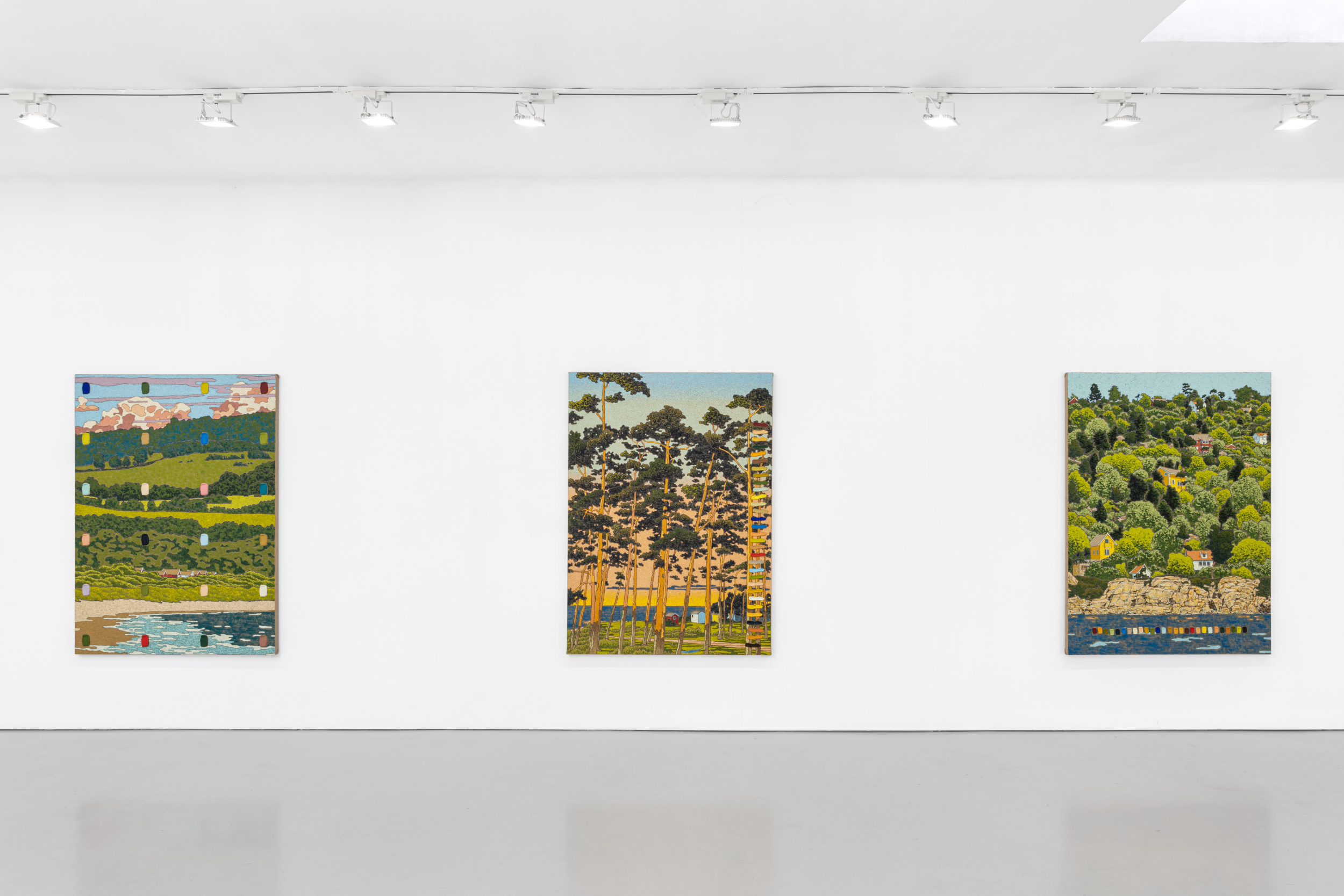
Luce Gallery proudly announce Landskap, an exhibition of paintings by Swedish born, Norway based, painter Peter Mohall. This is his fourth solo exhibition with the gallery and will be on view in Turin from March 21 – April 25, 2025.
As the Swedish lingual title implies, the exhibition thematic concern is with landscape painting. The coruscating landscapes of rural Scandinavian countryside captures the regional scenery, while the saturated imagery recalling the aesthetics of Post-impressionism, with embedded references to both regional painters like Helmer Osslund, Aleksi Gallen-Kallela and Willi Midelfart as well as idiomatic movements like Les Nabis, die Brücke, and Fauvism.
The specific material qualities of the traditional medium of choice, utilizing tempera grassa paint on jute canvas, along with a particular painting style, a sensitive brush handling and visual references, generates a distinct imagery that reveal a comprehension of the medium and it’s inherent art historical properties. Which is leading us to a tentative conclusion that the subject matter is subordinated by a conceptual inquiry into the medium.
The supporting evidence for this assumption comes in form of thick brush strokes sticked to the «window glass» of the illusionary window into the pictorial dimension. The brush strokes are «floating in the air» between us and the motif, causing our focus shift in and out between the pictorial dimension and the flat surface. The perceptual conflict destabilizes the narrative reading of the painting, leaving us with perceptual challenges searching for visual codes to decipher.
First thing we notice about the brush strokes are that they contain the colour index of the painting. Mohall invites us into his artistic process by sharing the palette. A point of interest is the opportunity to study the change of optic values of a colour from isolation compared to inclusion within the context of surrounding colours in the motif.
An interesting insight about the process is that Mohall has to calculate the numbers of colors to use in a painting in advance. Areas needs to be retained in order to properly attach the brush strokes directly onto the canvas. The brush strokes are often arranged as a grid, a note to the modernist method, or in alignment overlaying the motif.
Furthermore, the brush strokes are identical. Mohall has developed a signature strategy utilizing cast brush strokes in an inquiry into a medium-specific investigation of the relationship between the painterly authentic and automation. First deployed in a formalistic setting on empty canvases, the cast brush strokes thematize the gesture alluding the fusion of two modernist strategies; the brush stroke as subject matter and repetition. Mohall adapted the strategy using figuration as backdrops, innovating an imagery of complexity, multi-layered, with internal painterly discussions and perceptual challenges. A conflict between two image forms where traditional perception interacts with the implementation of modernist strategies.
Peter Mohall (b. 1979, Löddeköpinge(SE), lives and works in Nesoddtangen(NO) graduated from the Oslo National Academy of Fine Arts. He has exhibited throughout Europe, Asia and the United States, including solo shows with Luce Gallery, Turin, IT, Nino Mier, Los Angeles (US), Koki Arts, Tokyo(JP), Pablo’s Birthday, New York(US) and QB Gallery Oslo(NO). His work has been acquired by numerous collections such as Fondazione 107, Turin, IT, Central Bank of Norway, Oslo, NO; and JP Morgan Chase Collection, US, among others, as well as public commissions in both Oslo and Drammen.
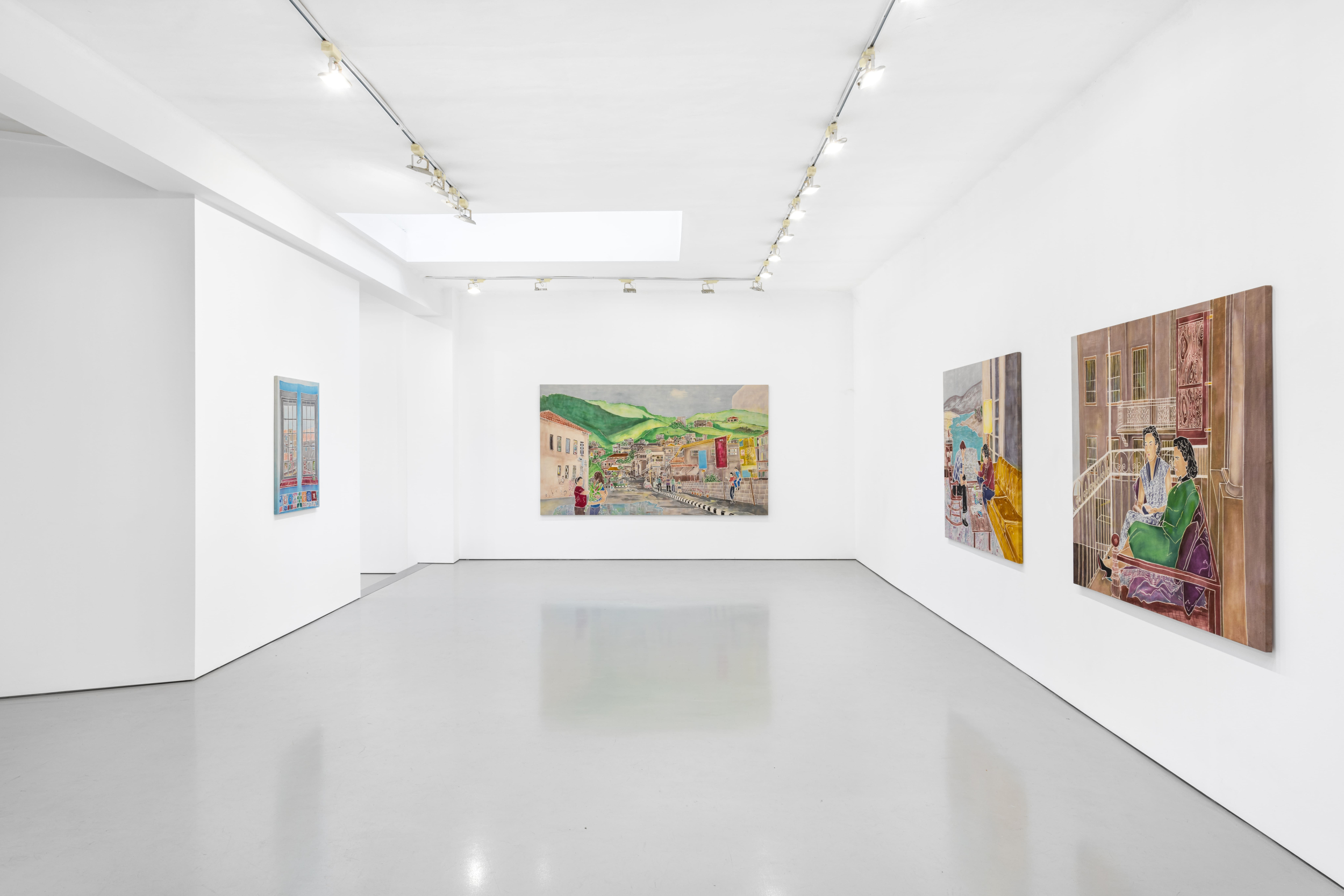
We are pleased to introduce Rachel Hakimian Emenaker, debuting her first solo exhibition with Luce Gallery, The Wind Will Carry Your Traces. Opening January 30, the show will feature eight batik paintings made from melted wax and hand applied dye. Through this unique approach, the artist reimagines and integrates ‘craft’ with the painting medium. Her composite cityscapes and interior scenes of everyday life convey profound familial and cultural histories, reflecting her diasporic upbringing. Hakimian Emenaker leans heavily into rich earth tones punctuated by vivid pops of burgundy, lemon, chartreuse, and indigo, heightening the visual impact of each composition. Her paintings are defined by thin yet saturated washes of dye, contrasted by crisp white linework that animates figures and details throughout each canvas. Together, the works in The Wind Will Carry Your Traces invite viewers to witness how diasporic histories and memories are integral in everyday life, fostering connections within communities.
The exhibition’s title, The Wind Will Carry Your Traces, poetically suggests how deeply held values and memories travel with us, shaping who we are no matter where we call home. Hakimian Emenaker’s ability to seamlessly blend Eastern and Western art traditions reflects her multicultural background and artistic journey infusing her work with remarkable depth. Of Armenian descent, she moved frequently during her formative years, living in Suriname, Russia and now the United States. This rich confluence of influences informs her work, drawing from European painting traditions, Armenian religious iconography, Soviet-era cinema, and ‘craft traditions’ from the Middle East and South America.
Having studied painting in undergraduate school, she gravitated toward the batik techniques she learned while growing up in Suriname, eventually integrating these methods with Western-style narrative compositions on canvas. Batik, a traditional Indonesian craft, involves creating intricate designs by applying melted wax to fabric and dyeing it in layers. The artist begins her process by drawing with melted wax to create distinctive, permanent lines on the canvas. As an unforgiving medium, wax leaves no room for error; every gesture—whether intentional or accidental—becomes a permanent element of the composition. After the wax dries, five to ten layers of dyes are applied with watercolor brushes, followed by a washing process to refine the colors. The canvas is then washed to remove the wax, leaving behind the crisp white lines that define their work. The final steps include drying, steaming the canvas flat, and attaching it to a stretcher, giving the piece a traditional painting appearance. This meticulous process is not only a technical feat but also a poignant metaphor for the artist's exploration of memory and cultural preservation.
A defining feature of Hakimian Emenaker’s work is the crisp white lines, which she describes as a form of “resistance.” Created by the wax’s resistance to dye, these lines give each painting a bold and cohesive structure. For the artist, this resistance symbolizes resilience in the face of erasure. The lines embody how people preserve and adapt cultural traditions, reconstructing memories into new forms that anchor them in a new home.
her seminal painting, Traces, a wide main street winds through a vibrant village nestled in the hillside, where terracotta tiled-roofed buildings, postwar apartments, and octagonal churches coexist. A family strolls along a sidewalk while two women converse nearby, standing near a large puddle that shares the town’s reflection and energy. Here figures are painted entirely from recollection, often referencing family members or acquaintances, making each encounter deeply personal yet universally resonant. As with all the artist’s paintings, this scene is reconstructed from fragmented memories, family stories, and vivid descriptions, forming a collective diasporic memory brimming with detail and artifacts. The rolling hills in the background could easily symbolize inherited memories of Kessab, Syria, where ancient churches rise above towns, or evoke the lush green hills of Los Angeles in springtime, seamlessly blending past and present. The painting captures the essence of the diasporic experience: a liminal space where the boundaries of time and place dissolve, allowing distinct cultural and historical influences to coexist in one richly layered composition.
The strength of Hakimian Emenaker’s work lies in her ability to harness the labor-intensive nature of their medium to emphasize its conceptual depth. Each scene she creates feels as though it could exist anywhere, everywhere, and nowhere all at once, creating this intersection of familiarity and vagueness where memory is most at home. Hakimian Emenaker layers diverse architectural styles and distinct cultural objects that embody the diasporic experience, illustrating how individuals adapt to new environments by bringing familiar elements of Eastern and Western cultures, as well as regional nature motifs, into their new lives. Her paintings present a convergence of cities, aesthetics, and past worlds, blending them into a seamless recreation of diasporic memory. These works invite viewers to consider how memories and cultural fragments persist, transform, and coexist in new spaces, encouraging deeper engagement with the vibrant and multifaceted nature of the diasporic experience.
Rachel Hakimian Emenaker (Armenian-American, b. 1992) is a Los Angeles-based artist working in painting, installation, craft, sculpture, sound, and textiles. In 2024, she earned an MFA from the University of California, Los Angeles. Her work has been featured in solo exhibitions at the UCLA Broad Art Center, Los Angeles (2024), and the American University of Armenia, Yerevan (2017), as well as in group exhibitions throughout California, including at the Museum of Contemporary Art, San Diego (2017). Emenaker is the recipient of the 2024 Dedalus MFA Fellowship in Painting & Sculpture and the 2023 UCLA Elaine Krown Klein Fine Arts Scholarship. Her work is included in international private collections.
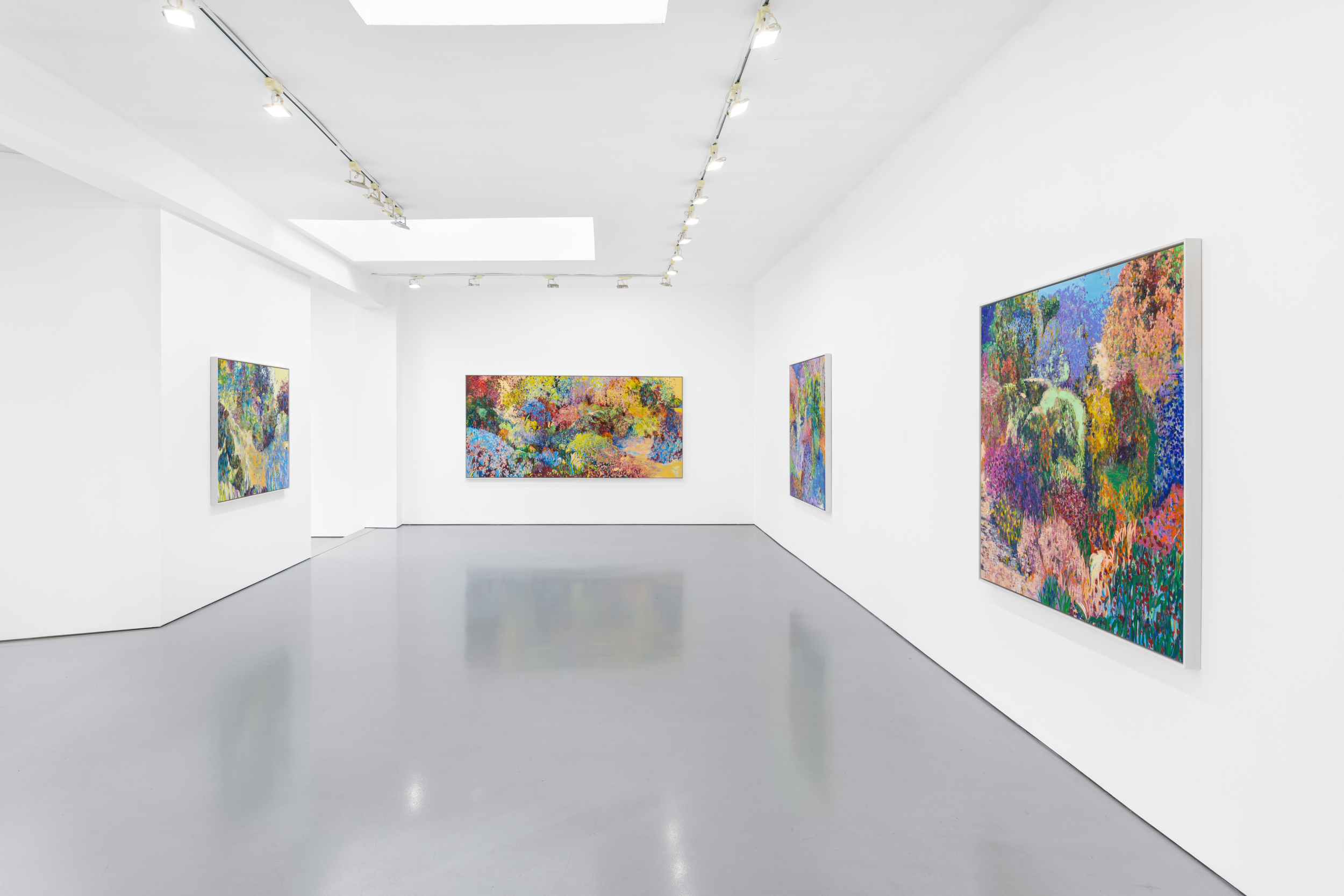
We are thrilled to introduce Connie Harrison, debuting her first solo exhibition with Luce Gallery titled, Bloomscapes. Opening October 24th, the show will feature eleven paintings incorporating her signature technique of layering wax paste and oil paint with incised lines. On view through December 20th, these abstract landscapes expose a deeper aesthetic beauty and celebration of nature’s complexity. Harrison employs an array of bright saturated hues - from rich jewel tones to glowing neons to soft pastels - pushing beyond the traditional landscape palette to captivate the eye. Her layered compositions are dense with lush vegetation, now featuring flowers, enlivened with quick rhythmic brushstrokes or carved directly into the surface, unveiling their inner beauty. Together, the paintings in Bloomscapes beacon viewers to wander through the awe inspiring forest nooks, uncovering overlooked details and encouraging peaceful reflection.
Harrison begins her artistic process by photographing Britain's ancient woodlands, lush garden scenes, and flower elements. She uses digital technology to overlay magnified floral outlines onto the landscapes, simultaneously working between these two compositions: distrorting and abstracting into one cohesive resolution. Her paintings often start with bright, almost neon underlayers that form an inner light, upon which she builds layers of oil paint and wax. This process creates a rich, velvety texture, while her technique of excavating the layers mirrors the natural cycles of growth and erosion - like seedlings bursting through the forest floor or heavy rain showers unearthing ancient sediments.
For Harrison, materiality is essential to her work. She sought a medium that could balance complexity with flatness, and texture with sculpted elements. Inspired by the rhythmic brushstrokes of French Impressionists, the saturated hues and flat compositions of Austrian Symbolist Gustav Klimt, and the techniques of atmospheric abstractions of American modernists like Helen Frankenthaler, Harrison developed an individualized bold approach. She masterfully balances intense color, opacity, and texture, by exposing wax and pigment with brushes and a sculpting stylist.
In her seminal work, Mirage at Dusk, pale pink rocky paths traverse through patches of goldenrod, periwinkle, and deep-violet flowers, while blades of magenta and dark turquoise grasses seem to emerge from beneath the rocks. All paths lead toward a dense wooded area, appearing as a kaleidoscope of hues, with an indigo sky looming through the forest canopy. In the background, dappled leaves echo the delicate petal structures in the foreground, while the smooth plane of the dark sky contrasts with the light-toned flatness of the rocks, instilling balance and harmony. Harrison’s potent colors, converging pathways, and vigorous brushstrokes infuse the painting with vibration, revealing a once concealed inner life force.
The strength of Harrison’s work lies in her abstract approach to landscapes, using the familiar subject to ‘organize’ her compositions and ultimately become vehicles for the sublime. She skillfully capitalizes on the duality of nature as both a refuge for a sensory relaxation and restoration, as well as a powerful force that presents great complexity and rhythm to inspire awe and wonder. Each experience coexists within the ‘bloomscape’, inviting viewers to wander through multiple paths of discovery and foster a deeper appreciation of nature's hidden beauty, escapism, and vitality.
Connie Harrison (British, b.1993) is a painter based in London, known for her vibrant, textured landscapes layered with oil paint and wax. Her process of excavation reveals the underlying depths of her compositions, metaphorically reflecting nature’s rhythms and life cycles. Harrison graduated with honors in 2016 from Chelsea College of Arts in the United Kingdom, after completing a foundational education at New College, Nottingham. Her work has been exhibited internationally including Dallas, Edinburgh, London, Los Angeles, New York, and Turin.


