
.jpg)
Luce Gallery is pleased to present artist Graham Collins's italian first solo show.In the exhibition the terms clean room and clean room design become metaphors for the gallery space and the production of artwork. A series of paintings are installed throughout the gallery. Appearing to cast reflections of the art and architecture in the room, these works are in fact matte, inkjet on canvas paintings. The apparent reflections are of an altogether different space; we see a mirror image of the art and architecture of the exhibition Clean Room, installed at Soloway Gallery, Brooklyn and running concurrently with this show. The paintings are hung to precisely project the mirrored ghost of the Soloway installation onto the Luce Gallery space. Dead spots in the Soloway reflection result in dead flat monochrome canvases.Two large, claro walnut slabs occupy the floor of the gallery space. Cut sequentially from the tree trunk, they have nearly identical shapes and a similar grain pattern. The slabs have been treated with a combination of traditional woodworking and DIY auto body techniques.The exhibition appears as an experimentation about the time, in the attempt to relive what meanwhile is happening on the other part of the ocean with feint reflection in a sort of a poetic recall.Graham Collins was born in 1980 in Washington, DC.Selected solo show are Concert in Central Park, Jonathan Viner, Londra, Soloway, New York, Civic, The Journal Gallery, New York, V8, Halsey McKay Gallery, East Hampton, NY.
.jpg)
In conjunction with Wes Noble, Amir Nikravan will present a group of his Parallax Paintings. This new series of work exploits the inherent possibility of replication that has emerged throught the process in which his works are made; a complex set of procedures that successively remove the physical object while preserving its traces as an image. Aiming to evince the gaps between image and experience, Nikravan's works present the viewer with objects that enact a frustrating disconnect between sight and touch, absence and presence, desire and possession. His Parallax Paintings, which explore the condition in which a seeming or apparent displacement on an object occurs throught a shift in point of view, further expand the artist's interest in imbiguing his works with perceptual, physical and psycological tension. Wes Noble is a collective artist. Making large minimal canvases, often depicting small signs, the attention is drawn to the meaning of symbols that focus the viewer to the details and the elegance of the representation. An ermetical approach is given to the free interpretation of the work, while the content of the canvas, somewhere between abstraction and figuration, let the whiteness of the background to a sort of infinity of the forms drawn like floating in the air.
Amir Nikravan lives and works in Los Angeles. A forthcoming solo exhibitioon at Various Small Fires, Los Angeles, will take place in September 2014. Past gallery exhibition include Greene Exhibitions, Pepin Moore and Rosamund Felsen Gallery.
Wes Noble lives and works in New York. Recent group shows include "Showtime" at Johannes Vogt, New York, "Doesn't even matter", V1 Gallery, Copenhgen, "Sad Plinth", Chelsea Mini Storage, New York, "Ce qui arretait, Ces dames", Galerie Jeanroch, Paris.
.jpg)
Luce Gallery is proud to present the group show Difference and Repetition, featuring new works by the artists Graham Collins, Ethan Cook, Nick Darmstaedter, Brendan Lynch and Chris Succo. The show is based on the concepts formulated by the French philosopher Gilles Deleuze in his book of the same title, in which he discusses the notion of identity of every single work, also when it draws its inspiration from the past or simply supplies interpretations of already explicated thoughts.
The exhibition represents an attempt to demonstrate how the philosophical-literary idea expressed at the end of the 1960s by Deleuze can be substantially linked to the visual arts, since in fact a large part of contemporary art embraces the principle that repetition should not be seen as generality, and “the exchange or substitution of particulars defines our conduct in relation to generality, we can see that repetition is a necessary and justified conduct only in relation to that which cannot be replaced” What has just been stated identifies a large part of what is expressed today in the world of contemporary art, where we are seeing new trends we consider substantially innovative, though they very rarely fully abandon the classical canons of the modern art of the '900s, taking their cue from it with references to the artists or the techniques utilized, as if to forge on with a path that cannot completely separate from the past. From the reinterpretation of certain classics and therefore from the wider use of the imaginary of the past, to simple inspiration drawn from specific conceptual elements with minimum use of the tool of repetition, the difference is contained in the identity of the work itself. “The introduction of a disequilibrium into the dynamic process of construction, produce an instability which appears only in the overall effect” and these elements establish a dialogue with the more generic aspect of the work, identifying it in its originality.
The five artists in the show, each with a different conceptual and media approach, present works that in some way make reference to the principle outlined above. Nevertheless, through their uniqueness and originality, they trace the principles modern art has expressed over the course of the
years, principles that are more alive than ever today; through their work, they constitute an extension of the principles themselves, helping the observer to understand them in a deeper way than in the past. We can notice this when, for example, we find works inspired by Warhol or by some of his series that perhaps at the time of their creation did not meet with particular success, or are considered to be of lesser visual impact today. Nevertheless, these are works that if reexamined, reformulated by today contemporary artists, can make us more fully understand the greatness of the Pop Art founder, since they have influenced the art of today. So the extension of the principle of repetition roots the referenced concept in a wider audience and makes its meaning more deeply understood, sharpening individuality.
Graham Collins lives and works in New York. Through the use of untreated materials like used wooden frames and stained glass, he makes works that can be considered true fusions between painting and sculpture. The work, as a whole, makes it possible to distinguish an intense physical approach. Through the meticulous construction of individual additive elements that bring out colorand transparency, but also the surfaces of rough wood, the result is a particularly elegant combination.
Ethan Cook also lives and works in New York. His works convey the sensation of paintings, but actually they do not involve the use of any paint. The work constitutes a rare reassertion of the talent of producing aesthetically appreciable results from an in-depth investigation of formalism. In his narration, he makes non-figurative works that also stand out for the refinement of the research on the materials used.
Nick Darmstaedter, considered one of the outstanding figures of the Still House Group of New York, has a multimedia approach that often makes use of the ready-made, in order to select iconography drawn from his own cultural roots. He brings out the collective imaginary and the dreams of the viewer, through careful compositions like the one included in this show, involving the
application of “fridge magnets” on aluminum sheets.
Brendan Lynch, also part of the Still House Group of New York, shows three diptychs that combine aspects of reinterpretation and the ready-made. Each work is composed of a painting made by the artist’s older brother, and one made by the artist himself. The work of the brother is used as a medium, while Lynch’s own painting is its abstract interpretation, a repetition conducted inside the repetition itself, in an original take on the concept of the show.
Chris Succo, who lives and works in Dusseldorf, presents his latest series of paintings, in which he first coats the canvas with spray paint and then covers it with gestural signs in white oil paint. As if the intention were to cover the design on the surface of the canvas, he applies materic layers of paint that highlight forms as in a bas relief, in an attempt to obtain an approach closer to sculpture than to painting. The random character of the forms finds a natural balance, thanks to monochromatic expanse lit up by veiled flashes of color.
.jpg)
Luce Gallery is pleased to present artist Hector Arce-Espasas's first solo show, Taste Responsibly. Taking a critical stance on stereotypes of the Caribbean world, the artist conducts a socio-political investigation of the history and symbology contained in the representation of tropical settings in mass culture, distorting their original meaning.“A cultural symbol corresponds to a precise historical period. Nevertheless, it can transcend its original function when its image is universally recognized. In this way, appropriation of the symbolic image gets adapted by subjective interest."In today’s culture, the idea of tropical paradise is idealized as escape from every day existence, recalling visions of a mythic Eden. Paradise, too, is the pursuit of happiness, where man surpasses his humble condition by entering into an exotic journey made of palm trees and the sea. Such mythic journeys are ready for appropriation, consumption, and export.Arce-Espasas is interested in the historical and mythological meanings of Tropical Paradise as they contrast with the symbols of today, becoming consumer goods within everyone’s reach. Interested in decoration, the artist explores the borders found between common useful objects and art forms, the dichotomy between that which can be considered artwork and that which is thought of as Kitsch, a notion that continuously changes over time.Taste Responsibility presents Arce-Espasas combination of elements of tropical imagery with others of a minimal nature. With the use of clay as a medium for painting, the artist creates the structure of his work, giving a nod to the materials found in sculpture. He explores the deconstruction and recombination of another symbolic image – the pineapple – in order to decontextualize its meaning as a fruit that represents the tropics, an emblem of friendship and hospitality.Arce-Espasas warns the viewer about the illusion conveyed by tropical images. The artist extends the metaphor by including a main installation of wooden crates once used for the exporting of pineapple, and by adding a screen print of a servant offering a pineapple to King Charles II. Additionally, he points to artifice through the pitcher, an object often associated in religious texts with purity and virtue, creating an ambiguous effect of dualism, in which all objects totter between mass production and decorative feature. Likewise, several sculpted pitchers of glazed ceramic evoke the forms of a bird, symbol of freedom and Tropical Paradise. In the dichotomy between ordinary object and art form, between historical references and present-day images, Hector Arce-Espasas reveals for us the transfigurations and illusions hidden within the everyday dream
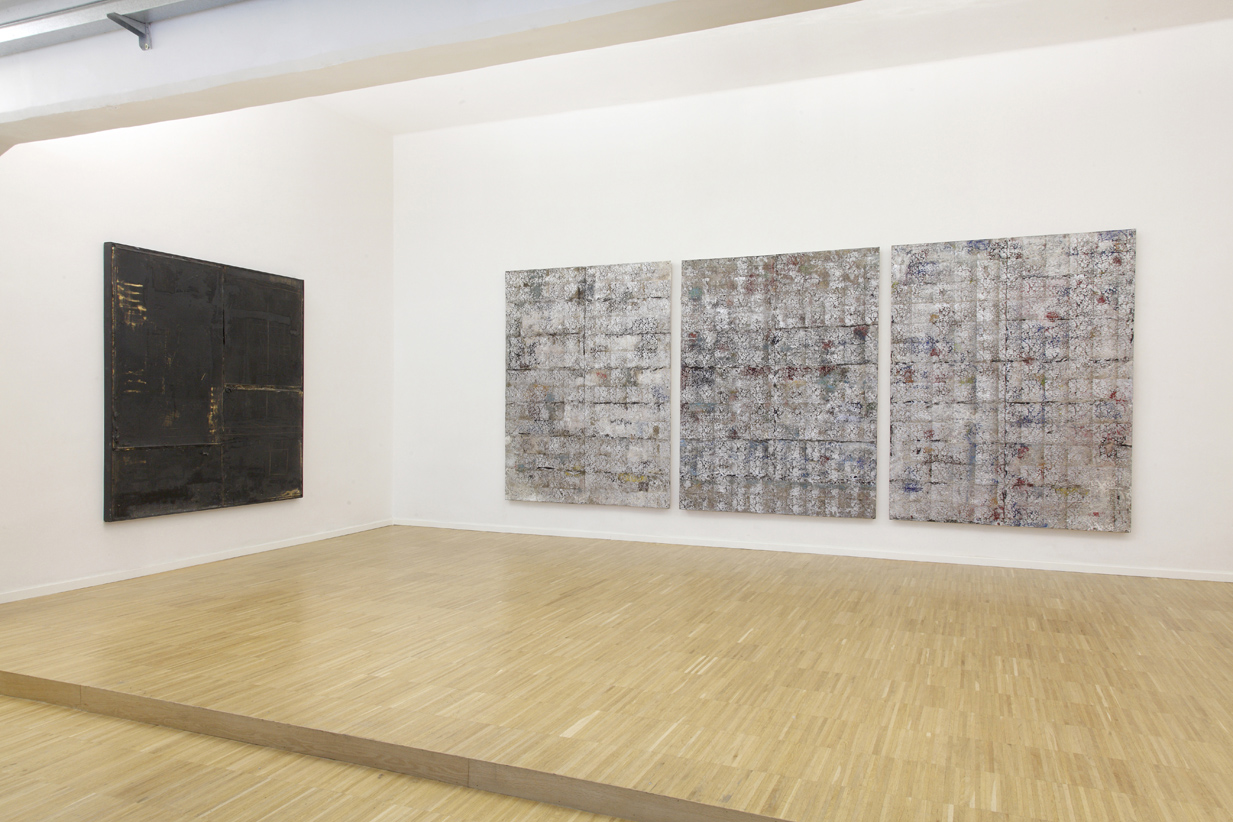
Through intense research in the workshop and the use of industrial materials like bitumen, aluminium sheet and oxidized steel plates, Hugo McCloud makes his works as if they were the framework of a modular construction. Assembling constituent forms that are extremely distant from the tradition of painting, in the classical sense, the research focuses on craftsmanship in creative intervention, and the sometimes arduous physical nature of the work, which engages the artist in the study of the material and its well-gauged grafting into the area of the work.
This approach lies in the experience of life and, first of all, in the voyages that are an important part of McCloud’s development, during which he has learned about different techniques originating in countries like India or South Africa, in an ongoing attempt to provide an unprecedented and timely reinterpretation of that semiotic vision time has been able to nurture in certain traditions extraneous to the Occident. It is in the combination of openness to the “other than self” and the filter of the American vantage point, through which the artist has always observed the world, that the work of McCloud arises, also drawing inspiration from the streets, in the midst of the urban refuse where he often finds abandoned metals or mattresses, from which he takes the images of his patterns sculpted in blocks of wood.
McCloud is self-taught, and concentrates on a kind of aesthetic refinement proudly detached from academic influences, specifically engaged with the cognitive potential of manipulation. The result is a compositional logic close to that of the “mosaic,” inserted in turn inside a vertical construction, the additive sum of each single part.
The artist, in his alchemical approach, alters the nature of materials, sublimating them in completed works. His practice questions the limits of the medium, joining components in a single imaginary that would otherwise have been demolished, or would have lived out the destiny shared by all things to become refuse. The work also incorporates the process of oxidation that corrodes, contaminates and transforms.
The resources for the work are found in bolts, panels, metal plates or gratings usually used in construction. All items used by McCloud to stimulate a materic fusion that shapes the object on the basis of the original idea, without ever overlooking their intrinsic properties; as in a voyage of human evolution that happens inside the limits of the cyclical rules of nature.
McCloud’s works often reflect the same theme in a pattern of repetitions, altered by a single imprint, done by means of manual pressure. The dynamism of the encounter of the different surface finishes betrays a timid reference to design, though in a more complex key, mingled with the fundamental principles of Arte Povera, viewed by the artist in a very particular way, far from any hypothesis of direct derivation.
While McCloud often expresses himself by composing monochromatic surfaces interrupted by certain distinctive tones, almost as if to establish a dialogue of perspective between multiple levels of reference, in other works he puts the accent on gesture, conveyed through the heat of the flame of the blow torch, which adds a new imprint to the material, altering its contours and shadings.
The artist intervenes in his creations in full awareness of the fact that he has only partial control over the final results, stemming from an incessant and never truly concluded dialectic between subject and object, observer and observed. To use the words of McCloud himself, from a recent interview: “Every time, I try to test the limits of manipulation of materials. And when I have found the answers to my questions, new questions arise...”
Contrarily to the classic painting where the artist add to the base pictorial substance to exalt the forms, in Muted Noise Hugo McCloud witness the wish to cover the colour adding proper elements like metallic foils, as to keep silent the source from which it is born the colour, but without darkening, rather exalting single parts that shine of proper light. Like is a eclipse, the light is covered allowing to glimpse the boarders of the same one, and single parts of colour assume even more vigor.

Robert Davis will present in March his first solo exhibition in our gallery with a new body of work.
With the use of unconventional materials like wine, beer, coffee or ash, and the combination of oil or oil-sticks, the artist uses elements that stimulate the ordinary life of every person to explore the boundaries between the different sensory perceptions related to the paintings in ways of optical perception combined with a more sensitive feeling that the materials reveal to the viewer.
Representing gestural forms, the artist shifts the point of interest to how the materials used react with the canvases, burlaps, linens or leathers that are supports for the paintings. These reactions depend on the individual type of material. Every wine or beer, for example, contains a different and unique palette and feeling. This variety of substances is accompanied by the gestural nature of the sign. The act of painting has to be seen in the gesture of rubbing, brushing, pouring or scratching.
"When I start a painting I don't want any reference points. The whole thing evolves visually so that there are never any preconceptions. My paintings have a close relationship to drawing and structure, to direction and rhythm. I like wine. I also like coffee and cigarettes. Viewing a painting is much like consuming it. We take it in and then decide whether we like it or not. On the other hand, I understand that painting is nostalgic. I love period pieces. I draw on that nostalgia for my palette and titles. My use of colour is the one thing in my practice that refers clearly to something outside itself. Certain events, room, places, things that I have read, heard or experienced in any way can dictate choice of colour. Then again sometimes I just want to make a painting blue. This same sense of nostalgia also informs the collage paintings. Sometimes a photo falls into my lap and it does what it is supposed to do. It is simply enough to adhere it to the canvas and it exists as a complete thing".
The artist’s additional incorporation of text, found images and unconventional materials acts as a break in intelligibility that calls attention to the code of modernist painting tropes. Naming Davis a code-breaker, however, misses the deeper impact of his work, which is all about affection. Updating Dubuffet's Materiologies, Davis uses base and addictive substances to gesture toward the real feeling of the world and our sense's inadequacy to understanding it. His titles are an important part of this, not just the name of a thing, but an indication of his serious and sentimental intentions.
"I know it's ok to be inspired by John Cougar Mellencamp as much as it is to be inspired by Malevich, I know it's ok to be a banker with a spray paint fetish, and I know when I'm looking at a Robert Davis painting I'm looking at something transcendent crafted from biblically elemental materials. Paintings made of wine and weed, coffee and cigarettes with their sacramental perfect linen below them, smears of history like Veronica's Veil above, the supports an altar for the marks". (V. Dermody)

.jpg)


